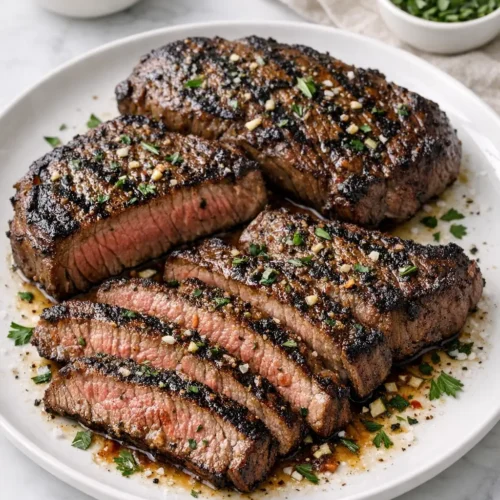
Father’s Day Steak Marinade with Garlic and Herbs

A Father’s Day steak marinade with garlic and herbs that seasons deeply and helps you get tender, juicy results. It uses pantry staples (soy sauce and Worcestershire) plus fresh garlic and herbs for big, steakhouse-style flavor that’s forgiving on a busy grill day.
Equipment
- Medium bowl or measuring jug
- Whisk
- Zip-top bag or shallow glass dish
- Paper towels
- Grill or heavy skillet (cast-iron or stainless)
- Tongs
- Instant-read thermometer
- Rack or plate
Ingredients
For the garlic and herb steak marinade
- 80 ml soy sauce about 1/3 cup; use low-sodium if desired
- 60 ml Worcestershire sauce about 1/4 cup
- 60 ml olive oil about 1/4 cup
- 30 ml fresh lemon juice about 2 tbsp
- 15 ml Dijon mustard about 1 tbsp
- 15 ml brown sugar packed; about 1 tbsp
- 4 cloves garlic finely minced (about 2 tbsp)
- 1 tbsp fresh rosemary finely chopped (or 1 tsp dried)
- 1 tbsp fresh thyme leaves finely chopped (or 1 tsp dried)
- 2 tbsp fresh flat-leaf parsley finely chopped
- 1/2 tsp freshly ground black pepper
- 1/4 tsp red pepper flakes optional
For the steak
- 680–900 g steak about 1 1/2–2 lb; 2–4 steaks, 2.5–3 cm (1–1 1/4 inches) thick; ribeye, strip, sirloin, or flank
- 1–2 tsp neutral oil for the grill grates or pan
- flaky sea salt to finish (optional)
- extra chopped parsley or rosemary for serving (optional)
Instructions
- Mix the marinade: In a medium bowl or measuring jug, whisk together the soy sauce, Worcestershire sauce, olive oil, lemon juice, Dijon mustard, brown sugar, minced garlic, rosemary, thyme, parsley, black pepper, and red pepper flakes (if using) until the sugar is mostly dissolved and the mixture looks emulsified.
- Prep the steak: Pat the steaks dry on both sides with paper towels. Trim thick pockets of hard outside fat if there are any, but leave most of the fat cap in place for flavor.
- Marinate the meat: Place the steaks in a zip-top bag or shallow glass dish in as close to a single layer as possible. Pour the marinade over the steaks, turning to coat all sides. Press out excess air if using a bag, seal, and massage gently so the marinade reaches all surfaces.
- Chill and marinate: Refrigerate for at least 1 hour and up to 8 hours, turning the steaks once or twice if they aren’t fully submerged.
- Bring to room temperature: 30–45 minutes before cooking, remove steaks from the fridge. Lift from the marinade (letting excess drip off) and discard the used marinade. Lay steaks on a rack or plate to take the chill off for more even cooking.
- Preheat your cooking surface: Heat a gas grill to medium-high (about 230–260°C / 450–500°F), prepare a hot direct-heat zone on charcoal, or preheat a heavy cast-iron or stainless skillet over medium-high until very hot.
- Oil the grates or pan: Lightly oil grill grates (with tongs and a folded oiled paper towel) or add 1–2 tsp neutral oil to the hot skillet to prevent sticking.
- Season lightly before cooking (optional): If you used low-sodium soy sauce, add a small pinch of salt to each side right before cooking; if you used regular soy, you may not need extra salt.
- Sear the first side: Place steaks on the grill or in the pan and cook without moving for 3–4 minutes for medium-rare on a 2.5–3 cm (1–1¼ inch) steak, aiming for a deep brown crust.
- Flip and monitor internal temperature: Flip and cook another 3–4 minutes, then begin checking with an instant-read thermometer (49–52°C / 120–125°F rare; 54–57°C / 130–135°F medium-rare; 60–63°C / 140–145°F medium; 66–68°C / 150–155°F medium-well). Pull the steak 2–3°C (3–5°F) before your target temperature for carryover cooking.
- Adjust for thinner or thicker steaks: For thinner steaks, reduce searing time by 1–2 minutes per side and check early. For very thick steaks (over 4 cm / 1½ inches), sear 2–3 minutes per side, then move to indirect heat (or a 180°C / 350°F oven) to finish until the thermometer shows your target.
- Rest the steak: Transfer cooked steaks to a warm plate or cutting board. Loosely tent with foil and rest 5–10 minutes.
- Slice and finish: Serve strip, ribeye, or sirloin whole if desired. For flank or long-grain cuts, slice thinly across the grain. Finish with flaky sea salt and extra chopped parsley or rosemary, if using.
Nutrition
Calories: 520kcalCarbohydrates: 6gProtein: 44gFat: 35gSaturated Fat: 9gCholesterol: 135mgSodium: 1050mgPotassium: 720mgFiber: 0.3gSugar: 4gVitamin A: 40IUVitamin C: 6mgCalcium: 35mgIron: 4.2mg
Tried this recipe?Let us know how it was!
