
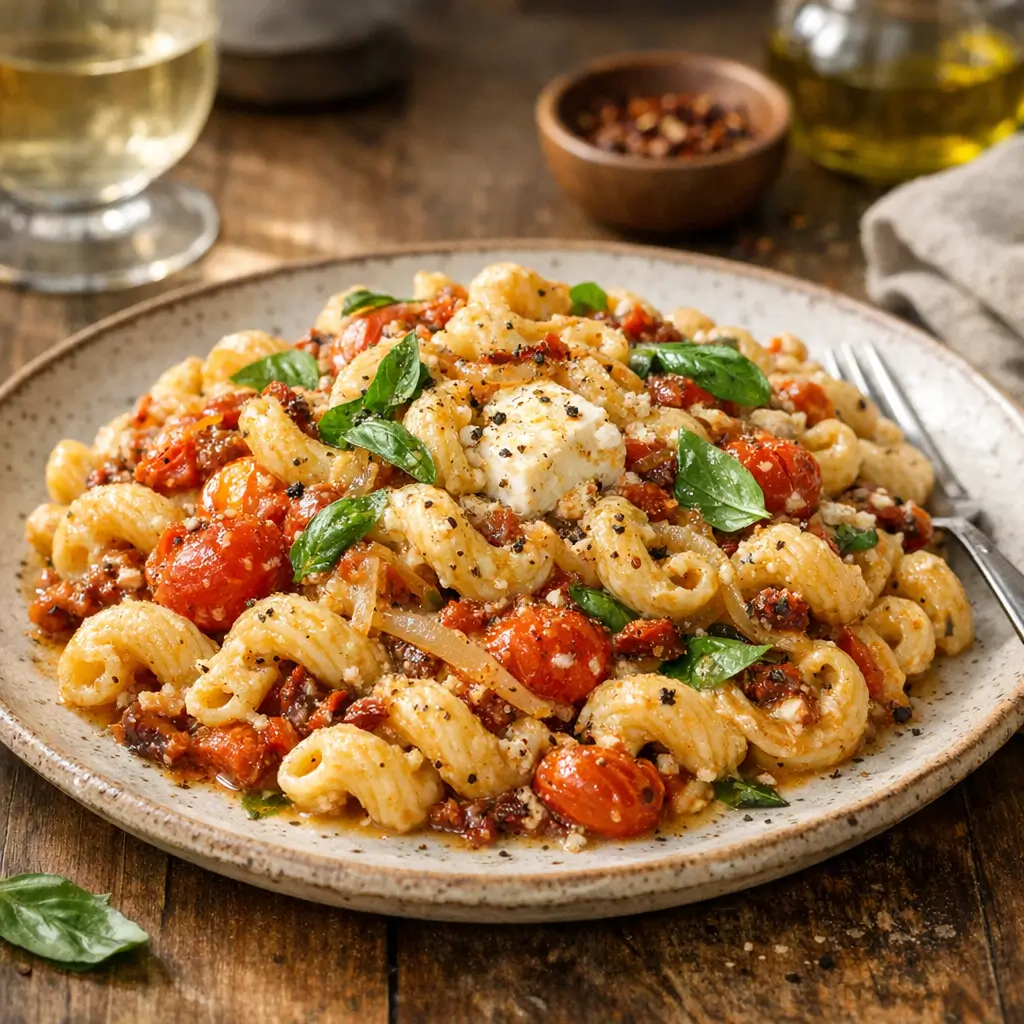
If you loved the original baked feta pasta but wanted more depth, this version leans into savory sweetness and concentrated tomato flavor. Baked Feta Pasta 2.0 keeps the hands-off oven method and adds quick caramelized onions and sun‑dried tomatoes for a sauce that tastes slow-cooked without the wait. The result is a creamy, tangy pasta with jammy tomatoes and silky onions that cling to every curve of your noodles.
It’s ideal for busy weeknights, date nights at home, or anytime you’ve got a pint (or two) of cherry tomatoes and a block of feta on hand. Expect a rustic, spoon‑coating sauce rather than a perfectly smooth one.
This dish was inspired by the viral baked feta pasta trend and the enduring appeal of roasted tomatoes with cheese. It’s familiar, flexible, and friendly to newer cooks but satisfying for seasoned ones, too.
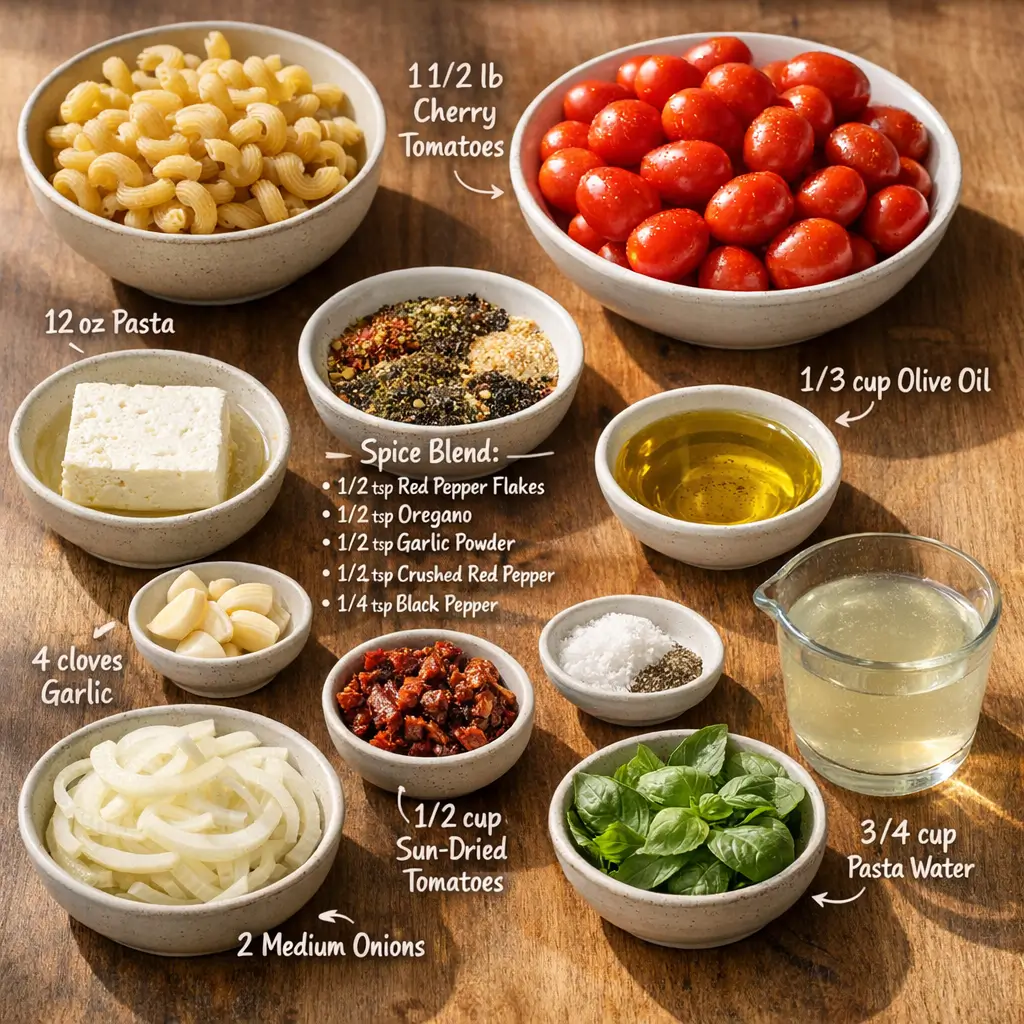
INGREDIENTS for Baked Feta Pasta 2.0
- 12 oz (340 g) short pasta such as cavatappi, rigatoni, or fusilli — shapes with ridges catch the sauce best.
- 1 1/2 lb (680 g) cherry or grape tomatoes — choose firm fruit; roasting concentrates even off‑season tomatoes.
- 8 oz (225 g) Greek feta, block in brine — for creamier melting. Avoid pre‑crumbled or cow’s‑milk feta; it can turn grainy.
- 1/3 cup (80 ml) extra‑virgin olive oil, plus 1 Tbsp (15 ml) for the onions — divided.
- 4 large garlic cloves, thinly sliced — aromatic base.
- 1/2 tsp red pepper flakes or 1 tsp Calabrian chile paste — optional heat.
- 2 medium (about 1 lb / 450–500 g) yellow onions, thinly sliced — for fast stovetop caramelization.
- 1/2 cup (75 g) sun‑dried tomatoes in oil, drained and chopped — boosts umami and tomato intensity.
- 1 tsp Diamond Crystal kosher salt (or 1/2 tsp Morton), plus more to taste — tomatoes and onions.
- 1/2 tsp freshly ground black pepper.
- 1/2 cup (12 g) loosely packed fresh basil leaves, torn — bright finish. Substitute parsley if basil isn’t great.
- 1 tsp lemon zest — optional, for lift.
- Reserved pasta water: 3/4 cup (180 ml) — thins and emulsifies the sauce.
STEP-BY-STEP INSTRUCTIONS
1) Heat the oven and set up the pan.
Preheat to 425°F (220°C) with a rack in the center. In a 13×9‑inch (3‑quart) baking dish, toss tomatoes with 1/3 cup oil, garlic, red pepper flakes (if using), salt, and black pepper. Nestle the feta block in the center and turn it once so it’s lightly coated in oil.
2) Bake until the tomatoes slump and the feta softens.
Roast 25–30 minutes, until most tomatoes are burst and jammy and the feta looks soft with lightly golden edges. If your oven runs cool, you may need up to 5 minutes more. Visual cue: tomatoes should be blistered and releasing juices; feta should give easily when pressed with a spoon.
3) Caramelize the onions while the oven works.
Heat 1 Tbsp oil in a wide skillet (10–12 inches) over medium heat. Add onions and a small pinch of salt. Cook, stirring every couple of minutes, until deep golden and tender, 16–20 minutes. If browning too fast, lower the heat; if the pan looks dry, splash in 1–2 Tbsp water to dissolve browned bits. Sensory check: they’re ready when they’re floppy, sweet, and smell nutty.
4) Boil the pasta.
Bring a large pot of well‑salted water to a rolling boil. Cook pasta just to al dente per the package (usually 8–10 minutes). Scoop out and reserve 3/4 cup pasta water, then drain.
5) Build the sauce in the baking dish.
Stir the chopped sun‑dried tomatoes into the hot baking dish. Add the caramelized onions. Use a fork to mash the softened feta into the tomatoes until creamy and emulsified, thinning with about 1/4 cup pasta water to start. You’re aiming for a loose, glossy sauce that will thicken as it grabs the pasta.
6) Toss and adjust.
Add the drained pasta and toss vigorously, adding more pasta water as needed (usually 1/4–1/2 cup more) until the sauce clings to each piece. Fold in basil and lemon zest (if using). Taste and season — remember feta and sun‑dried tomatoes bring salt, so add cautiously.
7) Finish and serve.
Let the pasta sit for 2 minutes so the starches finish thickening the sauce. Serve warm, with extra basil and black pepper.
Beginner safeguards:
- Don’t over‑salt the pasta water; the cheese and sun‑dried tomatoes are already salty.
- If your feta looks dry or crumbly rather than creamy after baking, whisk in a splash more hot pasta water and a drizzle of olive oil to help it emulsify.
- Work quickly after draining pasta; hot pasta helps the sauce come together.
WHAT TO EXPECT
- Texture: Expect a rustic, spoon‑coating sauce — creamy from feta, silky from onions, with soft tomato bits. It won’t be blender‑smooth, and that’s okay.
- Flavor: Sweet roasted tomatoes and caramelized onions balance feta’s tang and salt. Sun‑dried tomatoes add savory depth and concentrated tomato flavor; basil and lemon cut through richness.
- Variability: Greek feta in brine melts more luxuriously than pre‑crumbled or cow’s‑milk feta, which can stay grainy. Oil‑packed sun‑dried tomatoes are softer than dry‑packed; if using dry‑packed, soak them in hot water for 10 minutes first. Oven strength varies, so give your tomatoes the time they need to slump and blister.
WAYS TO CHANGE IT UP
-
Vegetarian or vegan adapted:
Use a plant‑based feta that melts well. For a dairy‑free pantry hack, crumble 8 oz (225 g) extra‑firm tofu and mix with 2 tsp white miso, 1 Tbsp olive oil, and 1 Tbsp lemon juice. Bake the tofu “block” with the tomatoes, then mash — the miso adds savory depth. Trade basil for parsley and add capers for extra brightness. Expect a less creamy, more crumbly sauce. -
Spicier or milder:
For heat, swap red pepper flakes for 1–2 tsp Calabrian chile paste, stirred into the tomatoes before roasting. For a milder version, skip chiles entirely and finish with extra basil and lemon zest for lift. -
Faster or simplified:
Skip stovetop caramelizing and add 1 thinly sliced shallot directly to the baking dish with the tomatoes; it roasts in the same time as the feta. You’ll miss the jammy onion sweetness, but it saves 15 minutes and one pan. You can also use jarred caramelized onions in a pinch, rinsed to reduce excess sweetness. -
Add‑ins and swaps:
Stir in a handful of baby spinach with the hot pasta to wilt it, or add 1/2 cup (60 g) pitted, chopped olives for briny contrast. Gluten‑free pasta works well; cook it under al dente so it doesn’t soften on toss‑through.
Trade‑offs are normal: Extra add‑ins dilute the sauce slightly; hold back some pasta water so the sauce doesn’t turn thin.
SERVING AND STORAGE
Serve hot, topped with more basil and black pepper. A crisp salad (romaine with lemon vinaigrette) or simply steamed greens balances the richness. Garlic bread or warm pita makes the sauce feel like a bonus course.
Wine pairing: A chilled, citrusy white (Sauvignon Blanc, Assyrtiko) or a light, juicy red (Lambrusco, Beaujolais) plays well with tomatoes and feta’s tang. Sparkling water with lemon keeps it weeknight‑friendly.
Storage: Refrigerate leftovers in a shallow container up to 3 days. The sauce thickens as it chills.
Reheating: Add a splash of water and a drizzle of olive oil to a skillet over medium heat and stir gently until loosened and glossy, 3–5 minutes. Microwave in short bursts, stirring between rounds, also works. Freezing isn’t recommended — feta can become mealy and the tomatoes watery when thawed.
CULTURAL CONTEXT
Baked feta pasta exploded on social platforms in early 2021, but the combination of roasted tomatoes and brined cheese long predates the trend. The cheese here is central: “Feta” is a protected designation (PDO) in the EU and refers to cheese made only in specific regions of Greece from mostly sheep’s milk. For a concise overview of how PDO feta is produced and why it tastes distinct, see the European Commission’s page on Feta PDO (European Commission).
Sun‑dried tomatoes, another pantry star in this recipe, have been used for preservation and flavor concentration for generations and saw a major popularity surge in the U.S. in the late 1980s and 1990s. For a brief background of their history and uses, see this summary (encyclopedic overview).
COMMON QUESTIONS AND TROUBLESHOOTING
1) My sauce looks grainy — what happened?
Graininess usually comes from pre‑crumbled or cow’s‑milk feta, which doesn’t melt as smoothly. Use a block of Greek feta in brine and mash it in the hot tomatoes. You can rescue a slightly grainy sauce by whisking in a few tablespoons of hot pasta water and a teaspoon of olive oil to help it emulsify.
2) The onions are browning but still firm. How do I fix it?
Turn the heat down and add 1–2 Tbsp water to the pan, scraping up browned bits. Continue cooking gently until they’re deep gold and soft. Wide pans speed caramelization; crowded or narrow pans slow it.
3) My tomatoes didn’t burst at 25 minutes. Should I keep baking?
Yes. Oven strength varies. Bake until tomatoes slump and blister, then mash with the feta. If they’re stubborn, broil for 1–2 minutes, watching closely. Slight charring adds pleasant bitterness that balances the sauce.
4) How do I avoid an overly salty result?
Taste strategically. Salt the tomatoes lightly upfront, then season at the end after combining feta, sun‑dried tomatoes, and pasta water. Use minimally salted pasta water (about 1 Tbsp kosher salt per 4 quarts water) and avoid salting again until you’ve tasted the final sauce.
5) Can I make it ahead?
You can caramelize the onions a day ahead and refrigerate. Rewarm gently before adding to the dish. Bake the tomatoes and feta just before serving for best texture.
6) What pasta shapes work best?
Short, ridged shapes (cavatappi, rigatoni, fusilli) catch the rustic sauce. Long strands can work but don’t hold as much sauce. Whole‑wheat and gluten‑free pastas are fine; adjust cooking time to keep them al dente.
7) Can I skip basil?
Yes. Substitute flat‑leaf parsley or a handful of baby arugula tossed in at the end. A pinch of dried oregano added to the roasting tomatoes is another classic, but use sparingly.
CONCLUSION
If you try this pasta, leave a comment with what worked in your kitchen — the pasta shape you picked, whether you used Calabrian chiles or kept it mild, and how the caramelized onions treated you. Your notes help other home cooks and keep this “2.0” version evolving in useful ways.



Leave a Reply