
Irish bacon and cabbage with parsley mustard sauce is a cozy, savory plate built for cool evenings and busy households. You simmer a small joint of ham or thick-cut bacon until tender, sauté a pile of sliced green cabbage in butter, then finish the whole thing with a quick mustard-parsley cream sauce that pools over everything on the plate.
If you’re walking in late on a weeknight, start by getting the bacon into the pot first; it can quietly simmer while you prep the cabbage and sauce. Cooking with kids underfoot or in a tiny kitchen? Keep the sauce pan at the back burner and focus on one pan at a time so nothing catches or boils over.
This dish shows up often in Irish home cooking and on pub-style menus, especially around colder months and St. Patrick’s Day, but it works year-round for anyone who likes comforting, salty pork and soft, buttery vegetables. Expect a simple, honest plate with just enough tangy cream sauce to keep it from feeling heavy.
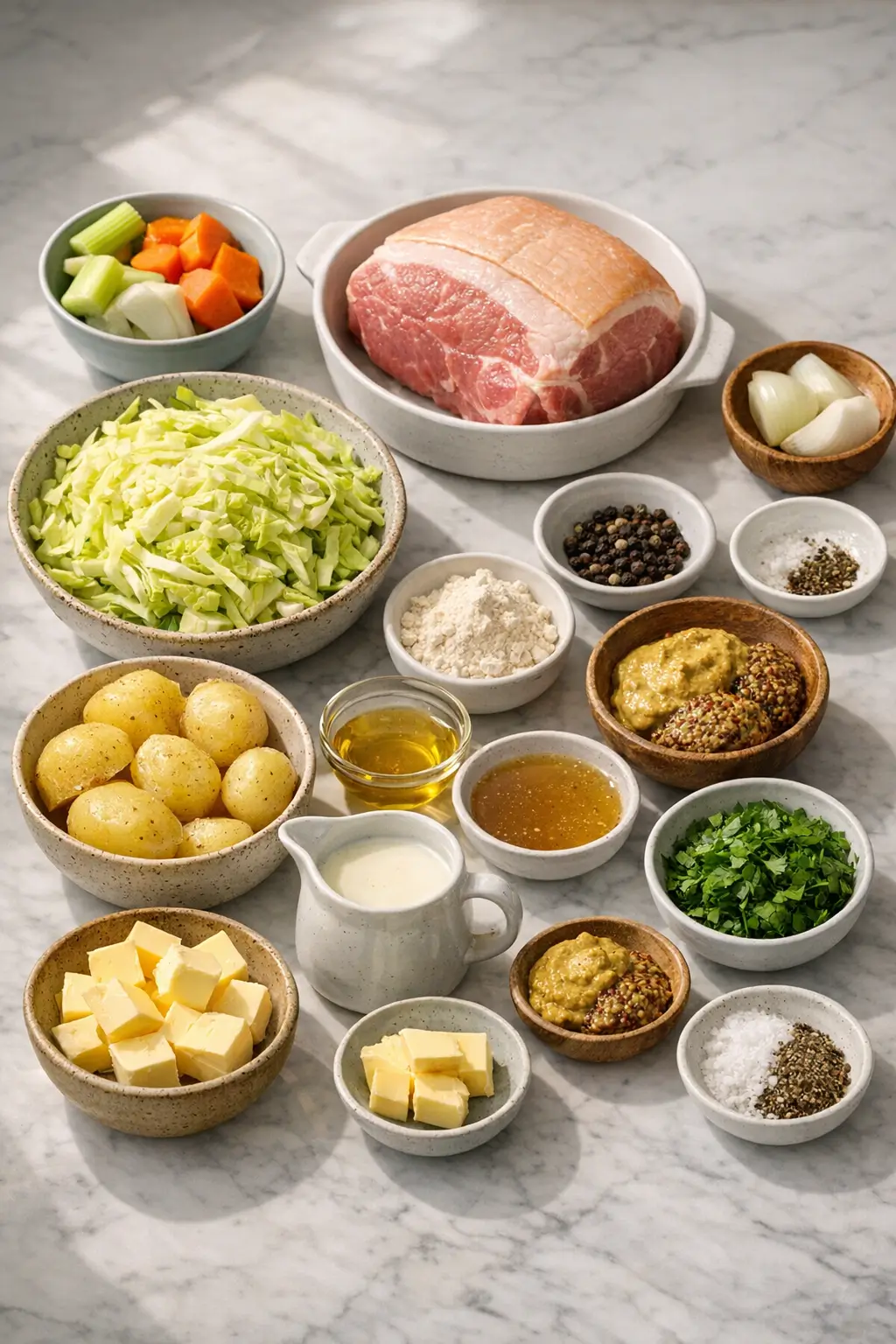
Ingredients
Serves 3–4
For the simmered bacon or ham
- 750 g–900 g (1.5–2 lb) piece of lightly salted ham or Irish-style boiling bacon, rind on if possible
- 1 medium onion, peeled and quartered
- 1 carrot, cut into chunks
- 1 celery stalk, cut into chunks (optional but adds flavor)
- 4–6 black peppercorns
- Cold water, to cover
Kitchen note: If your bacon is very salty, you may need to change the cooking water once after it first comes to a boil so the final dish isn’t overly salty.
For the buttery sautéed cabbage
- 1/2 medium green or Savoy cabbage (about 500–600 g / 1.1–1.3 lb), cored and thinly sliced
- 2 tbsp (30 g) unsalted butter
- 2 tbsp bacon cooking liquid or water
- Fine sea salt and freshly ground black pepper, to taste
For the parsley mustard cream sauce
- 2 tbsp (30 g) unsalted butter
- 2 tbsp (15 g) all-purpose flour
- 240 ml (1 cup) whole milk, plus a splash more if needed
- 60 ml (1/4 cup) bacon cooking liquid or low-sodium chicken broth
- 2–3 tsp Dijon mustard, to taste
- 1 tsp wholegrain mustard (optional, for texture)
- 3 tbsp finely chopped fresh flat-leaf parsley
- Fine sea salt and freshly ground black pepper, to taste
To serve (optional but recommended)
- 500–700 g (1–1.5 lb) floury potatoes, boiled or mashed
- Extra chopped parsley, for garnish
Step-by-Step Instructions for Irish bacon and cabbage with parsley mustard sauce
-
Start the bacon or ham.
Place the ham or bacon in a large, heavy pot and cover with cold water by about 2.5 cm (1 inch). Add the onion, carrot, celery, and peppercorns. -
Bring to a simmer and manage the salt.
Set the pot over medium-high heat and bring just up to a boil. If a thick white foam forms on top, carefully pour off the water, refill with fresh cold water, and return to the heat. Once it reaches a gentle simmer, reduce the heat to low so the surface barely moves. -
Simmer until tender.
Cover the pot partially and cook for about 45–60 minutes, turning the bacon once or twice, until it is completely heated through and tender. As a guideline, allow roughly 20 minutes per 450 g (1 lb), but start checking earlier if your piece is on the small side. -
Check doneness.
The meat should feel supple when you insert a fork, and an instant-read thermometer inserted into the center should read at least 63°C/145°F. Turn off the heat and let the bacon rest in the hot liquid while you cook the cabbage and make the sauce. -
Prep the cabbage while the bacon simmers.
Remove any tough outer cabbage leaves. Quarter the cabbage, cut out the core, then slice each wedge into thin shreds, about 5 mm (1/4 inch) wide. Rinse and drain well. -
Start the sautéed cabbage.
About 15 minutes before the bacon is done, set a large wide skillet (or sauté pan) over medium heat. Melt the butter until foamy, then add the sliced cabbage with a pinch of salt. -
Cook the cabbage until tender with a bit of bite.
Toss the cabbage in the butter, then add the bacon cooking liquid or water. Cover with a lid and cook for 5–7 minutes, stirring once or twice, until the cabbage is wilted and turning tender. -
Finish the cabbage.
Remove the lid and continue cooking for another 3–5 minutes, stirring occasionally, until most of the liquid has evaporated and the cabbage is glossy and lightly buttery. Taste and season with more salt and pepper as needed. Keep warm on low heat.
Kitchen note: Cabbage can swing from pleasantly tender to limp and sulfurous if cooked too long. If your pan is very hot or shallow, check it earlier and pull it once it’s just tender.
-
Make the roux for the sauce.
In a small or medium saucepan, melt the butter over medium heat. Sprinkle in the flour and whisk to make a paste. Cook, whisking frequently, for 1–2 minutes to remove the raw flour taste, but don’t let it brown deeply. -
Add the liquids gradually.
Whisk in the milk a little at a time, letting the mixture smooth out before each addition. Then whisk in the bacon cooking liquid or broth. Bring to a gentle simmer, whisking, until the sauce thickens enough to lightly coat the back of a spoon, 3–5 minutes. -
Flavor the sauce.
Turn the heat to low. Whisk in the Dijon mustard and, if using, the wholegrain mustard. Stir in the chopped parsley. Taste and season with salt and plenty of black pepper. If the sauce seems too thick, loosen with a spoonful or two of additional milk. -
Hold the sauce gently.
Keep the sauce on the lowest heat so it stays warm without boiling. Give it a stir now and then to prevent a skin from forming. -
Slice the bacon.
Lift the bacon from its cooking liquid and place it on a cutting board. Trim off the thick rind if present, leaving a thin layer of fat if you enjoy it. Slice the meat across the grain into thick slices. -
Plate the dish.
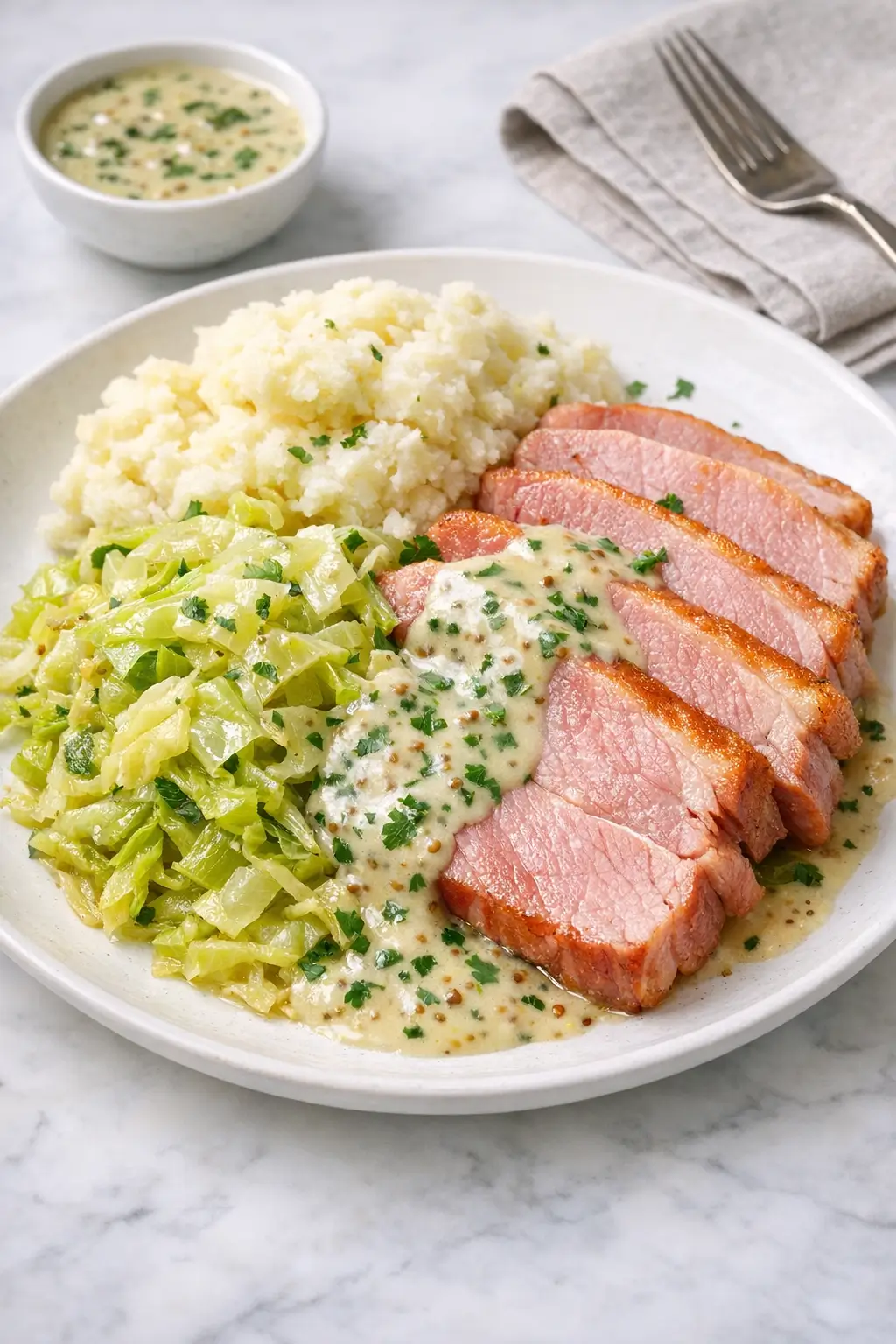
Spoon a generous bed of buttery cabbage onto each plate. Add a few slices of bacon or ham, then ladle some of the warm parsley mustard cream sauce over the top. Serve immediately with boiled or mashed potatoes on the side.
Kitchen note: If you’re juggling multiple pans, you can hold the sliced bacon in a low oven (about 100°C/210°F) for 10–15 minutes while you finish the cabbage and sauce. Just cover it loosely with foil so it doesn’t dry out.
What to Expect
You’ll end up with tender slices of salty, gently smoky pork, a mound of soft yet still structured cabbage, and a silky cream sauce that tastes lightly tangy from the mustard and fresh from the parsley.
The bacon should be well-seasoned but not aggressively salty. If you skipped changing the water and your joint was heavily cured, the meat and sauce may taste saltier; next time, start with a quick parboil in fresh water.
Cabbage cooked this way won’t be crisp like a stir-fry. Instead it should be velvety and slightly sweet, with a bit of chew at the thickest ribs. If you like a stronger bite, cook it for the shorter end of the suggested times.
Different brands and cuts of bacon can change the character of the dish. Leaner, ham-style pieces will give you cleaner slices and a lighter-tasting plate, while fattier pieces bring more pork richness into both the meat and the cooking liquid used for the sauce.
Kitchen note: Electric and induction stoves often run hotter than you expect at “medium”. If your sauce is thickening too fast or catching on the bottom, slide the pan off the heat for a minute and whisk in a spoonful of milk.
Ways to Change It Up
-
Make it vegetarian (or nearly so).
Swap the bacon for thick slices of sautéed or roasted cabbage steaks and serve them with the same parsley mustard cream sauce made with vegetable broth instead of bacon cooking liquid. For more protein, add a side of pan-fried halloumi or a scoop of buttery beans. -
Go fully dairy-free.
Use olive oil or dairy-free butter instead of butter in the cabbage and sauce, and replace the milk with unsweetened oat or soy milk. The sauce will be a bit less lush but still pleasantly creamy; mustard and parsley carry a lot of the flavor. -
Turn up the heat.
For a spicier version, whisk a teaspoon of hot English mustard or a pinch of cayenne into the cream sauce. You can also add a spoonful of prepared horseradish to bring a sinus-clearing kick. -
Simplify for an even faster dinner.
Instead of a whole joint, use thick-cut slices of back bacon or ham steaks. Brown them in a skillet, then add a splash of water, cover, and gently cook until heated through. Make the cabbage and sauce as written on the side. You’ll miss some of the flavorful cooking liquid, but gain speed. -
Add more veg.
Toss a handful of thinly sliced leeks or carrot matchsticks in with the cabbage during the last few minutes of cooking. They’ll soften into the mix and bring extra sweetness and color.
Serving and Storage
Serve Irish bacon and cabbage with parsley mustard sauce hot, with boiled or mashed potatoes to soak up the extra sauce. A slice of soda bread or crusty bread works well to sweep the plate.
Bright, simple sides help balance the richness. A quick green salad or something crisp and fresh like your favorite chopped salad or slaw is a good contrast. For another cozy, vegetable-forward option, a bowl of Tuscan white bean soup makes a complete, comforting meal alongside small portions of bacon and cabbage.
Leftovers keep well and almost improve overnight as the flavors settle. Cool everything quickly, then store the bacon, cabbage, potatoes, and sauce in separate airtight containers if you can.
In the fridge, bacon and cabbage keep for up to 3–4 days, while the sauce is best used within 3 days. Reheat the bacon and cabbage together in a covered baking dish with a splash of water at 160°C/325°F until hot, or warm them gently in a covered skillet.
Warm the sauce in a small saucepan over low heat, adding a spoonful of milk to loosen it if it has thickened. Avoid boiling, which can cause it to split.
Kitchen note: This dish doesn’t freeze especially well because of the cream sauce and cabbage, which can both turn grainy after thawing. If you do freeze leftovers, freeze the bacon separately and plan to make a fresh batch of sauce and cabbage later.
Cultural Context
Boiled or simmered bacon with cabbage and potatoes has long been a familiar part of Irish home cooking, where cured pork was an accessible, keepable source of protein. The combination often appears at everyday family tables and around St. Patrick’s Day, sometimes alongside other dishes like colcannon or soda bread.
Parsley sauce itself is a simple white sauce enriched with chopped parsley, seen in various European cuisines as a way to dress mild meats or vegetables. In Ireland, pairing it with bacon and cabbage creates a balance of salty, soft, and creamy on the plate.
For a concise overview of how bacon and cabbage fits into Irish culinary history, this short piece from the National Museum of Ireland is useful: Irish Food History Project. For a broader look at Irish food traditions over time, the Oxford Companion entry on Irish cooking, summarized by the Oxford Reference platform, offers additional context: overview of Irish food traditions.
Common Questions and Troubleshooting
My bacon came out too salty. Can I fix it next time?
If the finished dish was too salty, start by soaking your bacon joint in cold water for 1–2 hours in the fridge next time, changing the water once. When you cook it, bring it to a boil, discard that water, then add fresh water and simmer gently.
The cabbage tasted strong and sulfurous. What went wrong?
Cabbage develops stronger aromas when cooked for a long time at a rolling boil. Keeping the heat at medium, covering only briefly, and stopping the cooking once it’s just tender helps keep it sweet. Using a fresher head of cabbage also makes a difference.
My parsley mustard cream sauce went lumpy. How do I prevent that?
Lumps usually come from adding all the liquid at once to the roux or from not whisking enough at the start. Next time, add the milk gradually while whisking constantly, and let each addition smooth out before you add more.
Can I make parts of this in advance?
Yes. You can simmer the bacon up to a day ahead, keep it in its cooking liquid in the fridge once cooled, and rewarm it gently in that same liquid before slicing. The cabbage is best cooked close to serving time, but the sauce can be made a few hours ahead and reheated gently with a splash of milk.
Is there a good side dish if I don’t want potatoes?
Rustic breads and grain dishes work well here. A slice of Irish cheddar-scallion soda farls or a warm barley salad with herbs can stand in for potatoes and still soak up the sauce nicely.
Can I use regular American bacon?
Thin, streaky bacon will render too much fat and cook before the cabbage and sauce are ready. If you can’t find Irish-style back bacon or a small ham joint, look for thick-cut Canadian bacon or a small smoked pork loin, and adjust the simmering time so it doesn’t dry out.
Conclusion
Irish bacon and cabbage with parsley mustard sauce is a straightforward, satisfying way to bring cured pork, sweet cabbage, and a bright, creamy sauce together in one meal.
Once you’ve made it once or twice, you can adjust the mustard level, play with different cuts of bacon or ham, and tweak the cabbage texture to match what your household likes best.
If you try this version, consider leaving a comment or rating and share how you adapted it for your own kitchen—different cuts of meat, extra vegetables, or your favorite sides all help other home cooks find their way to a plate that works for them.

Irish Bacon and Cabbage with Parsley Mustard Sauce

Equipment
- Large heavy pot with lid
- Large wide skillet or sauté pan with lid
- Small or medium saucepan
- Whisk
- Cutting board
- Knife
- Instant-read thermometer (recommended)
Ingredients
For the simmered bacon or ham
- 750–900 g lightly salted ham or Irish-style boiling bacon 1.5–2 lb piece; rind on if possible
- 1 medium onion peeled and quartered
- 1 carrot cut into chunks
- 1 celery stalk cut into chunks (optional)
- 4–6 black peppercorns
- cold water to cover
For the buttery sautéed cabbage
- 1/2 green or Savoy cabbage about 500–600 g; cored and thinly sliced
- 2 tbsp unsalted butter
- 2 tbsp bacon cooking liquid or water
- fine sea salt to taste
- freshly ground black pepper to taste
For the parsley mustard cream sauce
- 2 tbsp unsalted butter
- 2 tbsp all-purpose flour
- 240 ml whole milk plus a splash more if needed
- 60 ml bacon cooking liquid or low-sodium chicken broth
- 2–3 tsp Dijon mustard to taste
- 1 tsp wholegrain mustard optional, for texture
- 3 tbsp fresh flat-leaf parsley finely chopped
- fine sea salt to taste
- freshly ground black pepper to taste
To serve (optional but recommended)
- 500–700 g floury potatoes boiled or mashed
- fresh parsley extra chopped, for garnish
Instructions
- Start the bacon or ham. Place the ham or bacon in a large, heavy pot and cover with cold water by about 2.5 cm (1 inch). Add the onion, carrot, celery, and peppercorns.
- Bring to a simmer and manage the salt. Set the pot over medium-high heat and bring just up to a boil. If a thick white foam forms on top, carefully pour off the water, refill with fresh cold water, and return to the heat. Once it reaches a gentle simmer, reduce the heat to low so the surface barely moves.
- Simmer until tender. Cover the pot partially and cook for about 45–60 minutes, turning the bacon once or twice, until it is completely heated through and tender. As a guideline, allow roughly 20 minutes per 450 g (1 lb), but start checking earlier if your piece is on the small side.
- Check doneness. The meat should feel supple when you insert a fork, and an instant-read thermometer inserted into the center should read at least 63°C/145°F. Turn off the heat and let the bacon rest in the hot liquid while you cook the cabbage and make the sauce.
- Prep the cabbage while the bacon simmers. Remove any tough outer cabbage leaves. Quarter the cabbage, cut out the core, then slice each wedge into thin shreds, about 5 mm (1/4 inch) wide. Rinse and drain well.
- Start the sautéed cabbage. About 15 minutes before the bacon is done, set a large wide skillet (or sauté pan) over medium heat. Melt the butter until foamy, then add the sliced cabbage with a pinch of salt.
- Cook the cabbage until tender with a bit of bite. Toss the cabbage in the butter, then add the bacon cooking liquid or water. Cover with a lid and cook for 5–7 minutes, stirring once or twice, until the cabbage is wilted and turning tender.
- Finish the cabbage. Remove the lid and continue cooking for another 3–5 minutes, stirring occasionally, until most of the liquid has evaporated and the cabbage is glossy and lightly buttery. Taste and season with more salt and pepper as needed. Keep warm on low heat.
- Make the roux for the sauce. In a small or medium saucepan, melt the butter over medium heat. Sprinkle in the flour and whisk to make a paste. Cook, whisking frequently, for 1–2 minutes to remove the raw flour taste, but don’t let it brown deeply.
- Add the liquids gradually. Whisk in the milk a little at a time, letting the mixture smooth out before each addition. Then whisk in the bacon cooking liquid or broth. Bring to a gentle simmer, whisking, until the sauce thickens enough to lightly coat the back of a spoon, 3–5 minutes.
- Flavor the sauce. Turn the heat to low. Whisk in the Dijon mustard and, if using, the wholegrain mustard. Stir in the chopped parsley. Taste and season with salt and plenty of black pepper. If the sauce seems too thick, loosen with a spoonful or two of additional milk.
- Hold the sauce gently. Keep the sauce on the lowest heat so it stays warm without boiling. Give it a stir now and then to prevent a skin from forming.
- Slice the bacon. Lift the bacon from its cooking liquid and place it on a cutting board. Trim off the thick rind if present, leaving a thin layer of fat if you enjoy it. Slice the meat across the grain into thick slices.
- Plate the dish. Spoon a generous bed of buttery cabbage onto each plate. Add a few slices of bacon or ham, then ladle some of the warm parsley mustard cream sauce over the top. Serve immediately with boiled or mashed potatoes on the side.



Leave a Reply