
Molasses baked beans with bacon in the oven are the sort of side that quietly bubbles away while you deal with the rest of dinner. The beans soften in a smoky-sweet sauce, the bacon turns crisp on top, and the whole pan goes from pantry staples to something that feels slow-cooked. You’ll run into versions of this dish anywhere classic American cookout or potluck food is served.
If you’re walking in the door on a busy weeknight, start by getting the oven heating and the bacon sliced so it can render while you open and rinse the beans. Cooking for a small kitchen? Use one oven-safe skillet or casserole so everything happens in a single pan.
These beans skew toward sweet and tangy with a gentle molasses bitterness and a noticeable bacon flavor. They suit newer cooks who want a forgiving recipe and more experienced cooks who like to tweak seasoning as it bakes. Expect tender beans in a glossy sauce, not restaurant-perfect symmetry.
Ingredients
Serves 4 as a generous side, 2–3 as a main
- 2 cans (about 400 g / 14–15 oz each) navy beans or great northern beans, drained and rinsed – neutral base that takes on flavor
- 8 slices (about 225 g / 8 oz) thick-cut bacon, cut into 1.25 cm / 1⁄2 inch pieces – provides smokiness and fat for the sauce
- 1 medium yellow onion (about 140 g / 5 oz), finely diced – adds sweetness and body
- 2 cloves garlic, minced – optional but helpful savory note
- 120 ml / 1⁄2 cup unsulphured molasses – deep, slightly bitter sweetness
- 80 ml / 1⁄3 cup ketchup – gentle tomato tang and body
- 45 g / 1⁄4 cup packed light brown sugar – rounds out the sweetness
- 30 ml / 2 tbsp apple cider vinegar – brightens and balances the molasses and sugar
- 15 ml / 1 tbsp Dijon mustard – mild heat and acidity
- 5 ml / 1 tsp Worcestershire sauce – background umami; use a vegetarian brand if needed
- 5 ml / 1 tsp smoked paprika – reinforces smoky flavor even if your bacon is mild
- 2.5 ml / 1⁄2 tsp ground black pepper, plus more to taste
- 2.5 ml / 1⁄2 tsp fine sea salt, plus more to taste (how much you need depends on your bacon and beans)
- 120 ml / 1⁄2 cup water or low-sodium chicken broth – helps the sauce loosen and reduce in the oven
Substitutions and notes:
- Beans: Cannellini beans work if navy beans are unavailable; they will be a bit creamier and more delicate.
- Bacon: Regular-cut bacon is fine; check a bit earlier so it doesn’t over-crisp. For a slightly leaner option, use half bacon and half diced smoked ham.
- Sweetener: You can replace half of the brown sugar with maple syrup for a different sweetness profile.
- Heat: Add a pinch of cayenne or 1 finely chopped, de-seeded jalapeño with the onion if you want a gentle kick.

Step-by-Step Instructions for Molasses Baked Beans with Bacon in the Oven
-
Preheat and choose your pan.
Set your oven to 175°C / 350°F with a rack in the middle.
Use a 2–2.5 liter (2–2.5 quart) oven-safe skillet or a similar-sized casserole dish so the beans sit in a relatively thick layer without overflowing. -
Render the bacon.
Place the bacon pieces in a large skillet over medium heat.
Cook, stirring occasionally, until the fat has mostly rendered and the edges are beginning to turn golden, 6–8 minutes.
You’re aiming for flexible, not fully crisp bacon at this stage.
Transfer the bacon with a slotted spoon to a plate, leaving about 2 tbsp of fat in the pan.
Kitchen note: If your bacon is very lean and doesn’t leave enough fat to coat the pan, add 1 tbsp neutral oil or a small knob of butter so the onion can soften without scorching.
-
Soften the aromatics.
Add the diced onion to the bacon fat in the skillet.
Cook over medium heat, stirring and scraping the pan, until the onion is translucent and starting to turn golden at the edges, about 5–7 minutes.
Stir in the garlic and cook just until fragrant, about 30 seconds. -
Build the molasses sauce.
Reduce the heat to low.
Whisk in the molasses, ketchup, brown sugar, apple cider vinegar, Dijon mustard, Worcestershire sauce, smoked paprika, pepper, salt, and the water or broth.
Stir until the sugar has dissolved and everything looks like a smooth, glossy sauce.
Let it come to a gentle simmer for 1–2 minutes; this helps the flavors start to meld. -
Combine with the beans.
Add the drained beans directly to the skillet if it’s oven-safe.
If not, pour the beans into a lightly greased casserole dish and scrape the sauce over the top.
Gently fold with a spatula until every bean is coated, taking care not to mash them.
Taste the sauce around the beans; it should taste slightly saltier and sweeter than you want the finished dish, because the beans will absorb some of both. -
Top with bacon.
Scatter the partially cooked bacon evenly over the surface.
Try to keep the bacon pieces in a single layer so they can render further and crisp instead of steaming.
Kitchen note: If your pan seems very full once the bacon is on, slide a sheet pan underneath in the oven. This catches any bubbling-over sauce and saves you from cleaning burnt sugar off the oven floor.
-
Bake until bubbly.
Transfer the pan to the oven and bake, uncovered, for 35–45 minutes.
The sauce should be actively bubbling around the edges and visibly thicker.
Begin checking at 30 minutes; thinner pans and electric ovens can run hot and reduce the sauce more quickly. -
Adjust texture at the end.
For thicker beans with a stickier sauce, leave them in for the full 45 minutes, or up to 55 minutes if your beans were quite wet going in.
For looser beans with more scoopable sauce, pull the pan earlier.
If the bacon is not as crisp as you’d like when the sauce texture looks right, run the pan under the broiler for 2–3 minutes, watching closely. -
Rest and season.
Remove the beans from the oven and let them sit for 10–15 minutes.
This short rest allows the sauce to thicken further as it cools slightly.
Taste and adjust salt, pepper, or a splash more vinegar if the beans feel too sweet.
Kitchen note: If you accidentally reduce the sauce too much and the beans look dry, stir in 2–4 tbsp hot water or broth right after baking, then let them sit for 5 minutes to rehydrate the sauce.
What to Expect
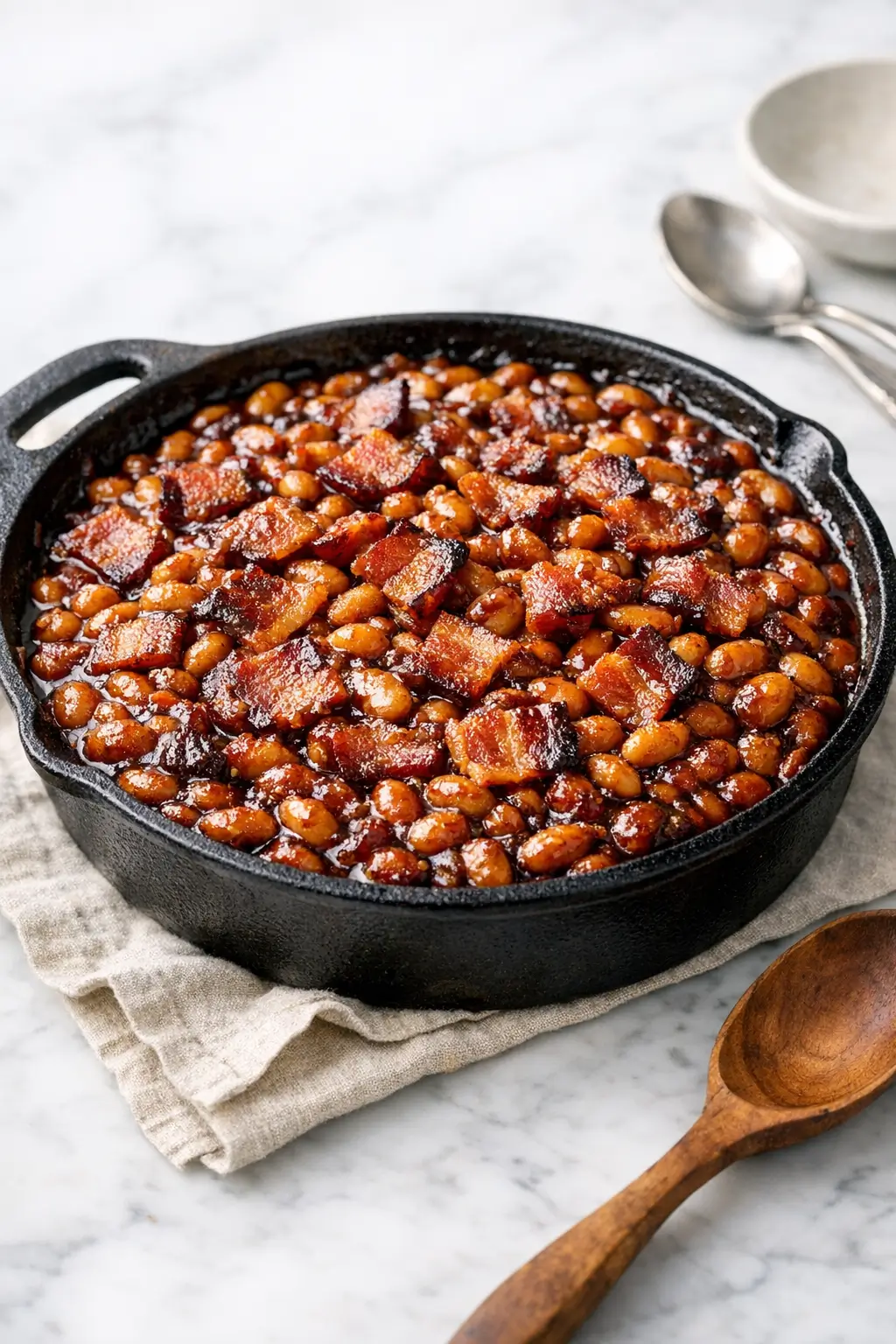
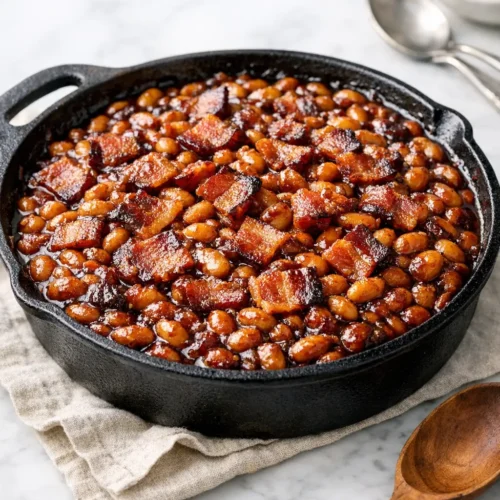
These molasses baked beans finish with a thick, glossy sauce that clings to the beans and spoon.
The beans themselves should be tender but still hold their shape; a few broken beans along the edges are normal.
The bacon on top turns chewy-crisp, especially if you broil briefly at the end.
Flavor-wise, expect a clear molasses presence—dark, slightly bitter, and deep—balanced by brown sugar and ketchup for sweetness and apple cider vinegar and mustard for tang.
Smoked paprika and bacon bring a gently smoky, savory layer rather than an aggressive barbecue flavor.
If your molasses is particularly robust, you may notice a bit more bitterness; that’s where an extra teaspoon of brown sugar or a drizzle of maple syrup after baking can round things out.
Different ovens and pans will give slightly different results.
A heavy cast-iron skillet tends to give a more reduced, caramelized sauce at the edges, while a glass casserole bakes more evenly but a bit gentler.
If you start with beans that are very wet or not fully drained, the sauce will be looser and may need those extra few minutes of baking to concentrate.
Ways to Change It Up
-
Vegetarian or vegan version.
Omit the bacon and use 2 tbsp neutral oil to sauté the onion.
Swap the Worcestershire sauce for a vegetarian version or 1 tsp soy sauce.
To get some of the smoky depth back, increase the smoked paprika to 1 1⁄2 tsp and add a drop or two of liquid smoke if you keep it on hand.
The texture will be slightly lighter without the bacon fat, but the beans will still be rich and satisfying. -
Spicier beans.
Add 1 finely chopped jalapeño (seeds removed for moderate heat) with the onion and garlic.
Stir in 1⁄4–1⁄2 tsp cayenne pepper with the other spices, depending on your heat tolerance.
You can also finish the pan with a few dashes of your preferred hot sauce before serving.
The extra spice sharpens the sweetness and makes the beans work well alongside grilled meats or sausages. -
Milder and less sweet.
If you prefer a more savory profile, reduce the brown sugar to 2 tbsp and add an extra 1 tbsp vinegar.
Use regular paprika instead of smoked for a softer flavor.
This version is helpful if the beans are part of a larger, already sweet menu (like a spread with cornbread and sweet sauces). -
Faster, simplified version.
Use 1 can of baked beans and 1 can of plain navy or great northern beans instead of all plain beans.
Skip the garlic and Worcestershire sauce and reduce the brown sugar to 1 tbsp, since canned baked beans are already sweet.
You can whisk together only molasses, ketchup, vinegar, mustard, and smoked paprika for the sauce.
This trims a few ingredients while keeping the overall character of the dish.
Serving and Storage
Molasses baked beans with bacon are usually served warm as a side dish.
They sit comfortably next to grilled chicken, burgers, sausages, or pulled pork, but also work with roasted vegetables or a big salad if you want to keep things simpler.
For a more substantial meal, spoon them over toast, baked potatoes, or alongside fried or poached eggs.
Because the beans are naturally rich and a bit sweet, pair them with something crisp or acidic.
Think coleslaw with a vinegar-forward dressing, simple pickled cucumbers, or a sharply dressed green salad.
If you’re planning a cookout-style spread, they work well alongside cornbread, potato salad, or grilled corn.
Leftovers keep well.
Cool the beans completely, then transfer to an airtight container and refrigerate for up to 4 days.
Reheat gently on the stovetop over low heat with a splash of water, stirring occasionally, until just hot.
You can also microwave in short bursts, stirring between each, to prevent hot spots.
The beans freeze fairly well because the sauce is robust.
Portion into freezer-safe containers, leaving a little headspace, and freeze for up to 2 months.
Thaw overnight in the refrigerator, then reheat as above.
Cultural Context
Sweetened baked beans with pork or bacon appear in many parts of what is now the United States, with a particularly strong association with New England.
Boston baked beans are a well-known example, typically flavored with molasses and salt pork or bacon and historically cooked for long periods at low heat.
The use of molasses is tied to regional trade histories and the availability of this sweetener in coastal cities.
For more on this background, the Smithsonian’s National Museum of American History offers a short piece on the history of Boston baked beans and molasses in the region: Boston baked beans historical overview.
A general look at the dish and its place in New England food culture can also be found here: background on Boston baked beans.
Common Questions and Troubleshooting
Why are my beans still too firm?
When starting with canned beans, this is uncommon, but some brands are firmer than others.
If your beans feel too firm after baking, stir in 2–4 tbsp hot water, cover the pan with foil, and return it to the oven for 10–15 minutes.
Next time, you can bake at the same temperature but extend the time by 5–10 minutes and check earlier on the sauce thickness.
The sauce seems too runny. What should I do?
First, let the beans rest for at least 10–15 minutes; the sauce thickens noticeably as it cools slightly.
If it’s still looser than you’d like, return the uncovered pan to a 175°C / 350°F oven for another 10 minutes, or simmer gently on the stovetop, stirring often, until the sauce reduces.
Be cautious with the stovetop method: keep the heat low to avoid scorching the sugars on the bottom.
Kitchen note: If you’re planning to keep the beans warm on a buffet or in a low oven for a long stretch, pull them from the initial bake when the sauce is just a bit looser than you want; they will continue to thicken as they hold.
Can I reduce the sugar or molasses?
Yes, but do it gradually so the sauce doesn’t lose all of its body and character.
Try reducing the brown sugar to 1–2 tbsp before cutting back the molasses; the molasses contributes both flavor and thickness.
If you significantly reduce both, you may want to increase the ketchup slightly so the sauce still has structure.
Can I make this ahead?
You can bake the beans up to 1 day in advance, cool completely, and refrigerate.
Reheat in a 165–175°C / 325–350°F oven, covered with foil, for 20–30 minutes until hot.
If the sauce has thickened a lot in the fridge, add a splash of water or broth before reheating and stir halfway through.
The bacon will lose some crispness but the flavor holds up well.
What if I don’t have apple cider vinegar?
White wine vinegar or red wine vinegar both work, though they taste slightly sharper.
Use 1 tbsp to start, taste after baking, and add a little more if the beans still feel too sweet.
Fresh lemon juice can also stand in during the final seasoning step, added right after baking.
Conclusion
These molasses baked beans with bacon are designed to be practical: mostly pantry ingredients, a single pan if you plan it that way, and a forgiving oven bake that doesn’t demand constant attention.
Use the base recipe once to get a feel for how your oven and beans behave, then adjust the sweetness, tang, and heat to suit your table.
If you make them, leave a comment with what you served alongside, any swaps you tried, or how you tweaked the seasoning so other home cooks can borrow your ideas.
Molasses Baked Beans with Bacon in the Oven

Equipment
- Oven-safe skillet or casserole dish (2–2.5 quart)
- Large skillet
- Slotted spoon
- Spatula
- Whisk
Ingredients
- 2 cans navy beans or great northern beans about 400 g / 14–15 oz each, drained and rinsed
- 8 slices thick-cut bacon about 225 g / 8 oz, cut into 1/2-inch pieces
- 1 medium yellow onion finely diced (about 140 g / 5 oz)
- 2 cloves garlic minced (optional)
- 120 ml unsulphured molasses 1/2 cup
- 80 ml ketchup 1/3 cup
- 45 g light brown sugar packed (1/4 cup)
- 30 ml apple cider vinegar 2 tbsp
- 15 ml Dijon mustard 1 tbsp
- 5 ml Worcestershire sauce 1 tsp
- 5 ml smoked paprika 1 tsp
- 2.5 ml ground black pepper 1/2 tsp, plus more to taste
- 2.5 ml fine sea salt 1/2 tsp, plus more to taste
- 120 ml water or low-sodium chicken broth 1/2 cup
Instructions
- Set your oven to 175°C / 350°F with a rack in the middle. Use a 2–2.5 liter (2–2.5 quart) oven-safe skillet or a similar-sized casserole dish so the beans sit in a relatively thick layer without overflowing.
- Place the bacon pieces in a large skillet over medium heat and cook, stirring occasionally, until the fat has mostly rendered and the edges are beginning to turn golden, 6–8 minutes. Transfer bacon with a slotted spoon to a plate, leaving about 2 tbsp of fat in the pan.
- Add the diced onion to the bacon fat. Cook over medium heat, stirring and scraping, until translucent and starting to turn golden at the edges, about 5–7 minutes. Stir in the garlic and cook just until fragrant, about 30 seconds.
- Reduce heat to low. Whisk in the molasses, ketchup, brown sugar, apple cider vinegar, Dijon mustard, Worcestershire sauce, smoked paprika, pepper, salt, and the water or broth. Stir until smooth and glossy and the sugar dissolves, then let it gently simmer 1–2 minutes.
- Add the drained beans to the oven-safe skillet (or transfer beans to a lightly greased casserole and scrape sauce over). Gently fold until all beans are coated, taking care not to mash them. Taste and adjust seasoning if needed.
- Scatter the partially cooked bacon evenly over the surface in a single layer so it can crisp instead of steaming.
- Bake uncovered for 35–45 minutes, until the sauce is actively bubbling at the edges and visibly thicker. Start checking at 30 minutes.
- Adjust texture: bake longer (up to 55 minutes) for thicker, stickier beans, or pull earlier for a looser, more scoopable sauce. If the bacon isn’t crisp enough when the sauce is right, broil 2–3 minutes, watching closely.
- Let the beans rest 10–15 minutes to thicken. Taste and adjust salt, pepper, or add a splash more vinegar if the beans feel too sweet.



Leave a Reply