
If you love the comfort of lasagna but dread boiling noodles, this playful bake is for you. Ramen lasagna stacks instant ramen, tomato sauce, and cheese into a bubbling, golden pan that hits all the weeknight notes: cheap, quick to assemble, and family‑friendly.
It borrows the idea from viral social videos and brand sites, then adds real‑kitchen guardrails so your first try turns out right. Expect a tender, springy bite from the ramen and stretchy mozzarella on top.
This is perfect for busy cooks, college students, and anyone craving a cozy, saucy dinner without a sink full of pots. Serve it on cool nights or any time you want low‑stress comfort food. Ramen Lasagna delivers that baked‑pasta satisfaction with minimal effort.
INGREDIENTS
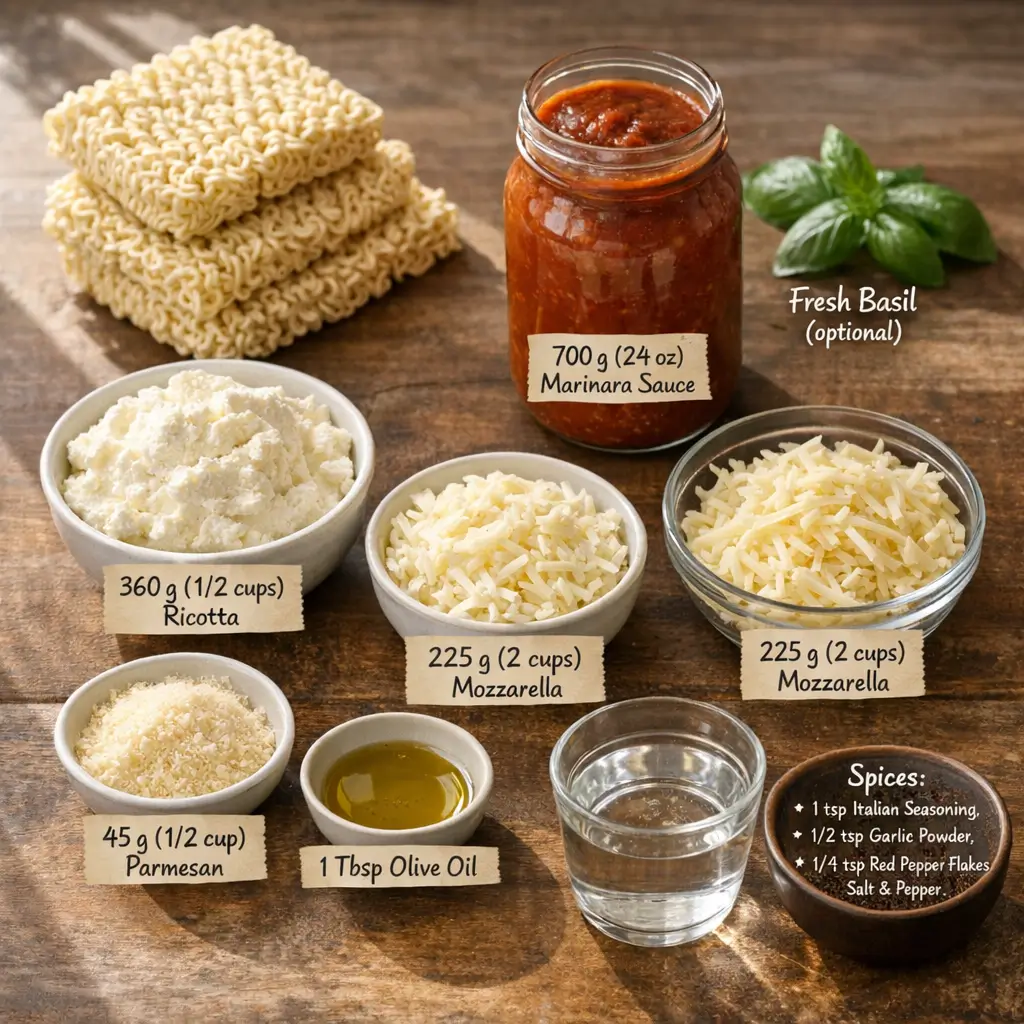
- 4 (85 g/3 oz each) instant ramen bricks, seasoning packets discarded or reserved for another use; about 340 g/12 oz total (no need to boil)
- 700 g (24 oz) jar marinara or tomato pasta sauce — provides moisture to cook the noodles
- 360 g (1 1/2 cups) whole‑milk ricotta — creamy middle layer
- 225 g (2 cups) low‑moisture mozzarella, shredded — melty top and layers
- 45 g (1/2 cup) Parmesan, finely grated — salty finish
- 180 ml (3/4 cup) water or low‑sodium broth — ensures ramen hydrates fully
- 1 tablespoon olive oil — to grease the dish and prevent sticking
- 1 teaspoon Italian seasoning — optional, to perk up jarred sauce (or use *1/2 teaspoon dried basil + 1/2 teaspoon dried oregano)
- 1/2 teaspoon garlic powder — optional (or 1 small garlic clove, minced)
- 1/4 teaspoon red pepper flakes — optional for a gentle kick
- Fine salt and black pepper — to season ricotta to taste
- Fresh basil or parsley for garnish — optional
Substitutions that work:
- Cottage cheese (small‑curd) can replace ricotta 1:1; drain briefly for best texture.
- Use part‑skim mozzarella if that’s what you keep on hand; it browns a touch faster.
- If your sauce is very thick, thin it with 2–4 tablespoons water to mimic a pourable marinara.
- Gluten‑free instant ramen works; check package for weight and add a splash more water if blocks are thicker.
STEP-BY-STEP INSTRUCTIONS: RAMEN LASAGNA
- Preheat and prep the dish.
- Heat the oven to 350°F (175°C). Lightly oil an 8‑inch square (or 2‑quart) baking dish. A metal pan runs hotter than ceramic, so start checking for doneness a few minutes earlier if using metal.
- Season the ricotta.
- In a bowl, combine ricotta, 1/4 cup (25 g) of the Parmesan, a pinch of salt and pepper, Italian seasoning, and garlic powder. Stir until smooth. This makes it easier to spread over the dry noodles.
- Sauce the base.
- Spread 1/2 cup (120 ml) sauce over the bottom of the dish. This prevents the first layer of ramen from scorching and helps it soften.
- Build the first layer.
- Arrange 2 ramen bricks in a single layer to cover the base. If your dish is slightly smaller, snap off only the corners you must; keep pieces large so the lasagna slices neatly later.
- Dollop on half the ricotta mixture and gently spread to the edges.
- Spoon over about 1/3 of the remaining sauce (roughly 1 1/3 cups) and scatter 2/3 cup mozzarella.
- Add the second layer.
- Top with the remaining 2 ramen bricks.
- Spread on the rest of the ricotta, another 1/3 of the sauce, and 2/3 cup mozzarella.
- Finish the top and add moisture.
- Cover the noodles completely with the final 1/3 of the sauce, paying extra attention to the corners and edges so no dry noodle peeks through.
- Sprinkle the remaining mozzarella and all remaining Parmesan on top.
- Slowly pour the water or broth around the inside edges of the dish so it seeps under the layers without washing off the sauce. You should see liquid pooling slightly at the sides; that’s good.
- Bake covered, then uncover to brown.
- Cover the dish tightly with foil (tent it slightly so it doesn’t stick to the cheese). Bake for 30–35 minutes, until the sauce is bubbling at the edges.
- Carefully remove the foil—watch the hot steam—and bake 10–15 minutes more until the top is browned in spots and the center is bubbling. If your oven runs cool, you can raise heat to 375°F (190°C) for the final 5 minutes to encourage browning.
- Check tenderness and rest.
- Slide a thin knife or skewer into the center; it should meet just a little resistance, like al dente pasta. If it still feels stiff, add 2–4 tablespoons hot water around the edges, cover again, and bake 5–10 minutes more.
- Let the lasagna rest 10 minutes before slicing so the layers set. The top will relax from bubbling to gentle sizzling, and the cheese will firm up slightly for cleaner cuts.
Beginner safeguards:
- The biggest mistake is under‑saucing or leaving dry corners. Make sure every noodle edge is coated before baking.
- Don’t skip the foil. Covered baking gives the ramen time to hydrate so you don’t end up with crunchy centers.
- Jarred sauces vary. If yours is very chunky and thick, thin with a small splash of water so it spreads easily.
WHAT TO EXPECT
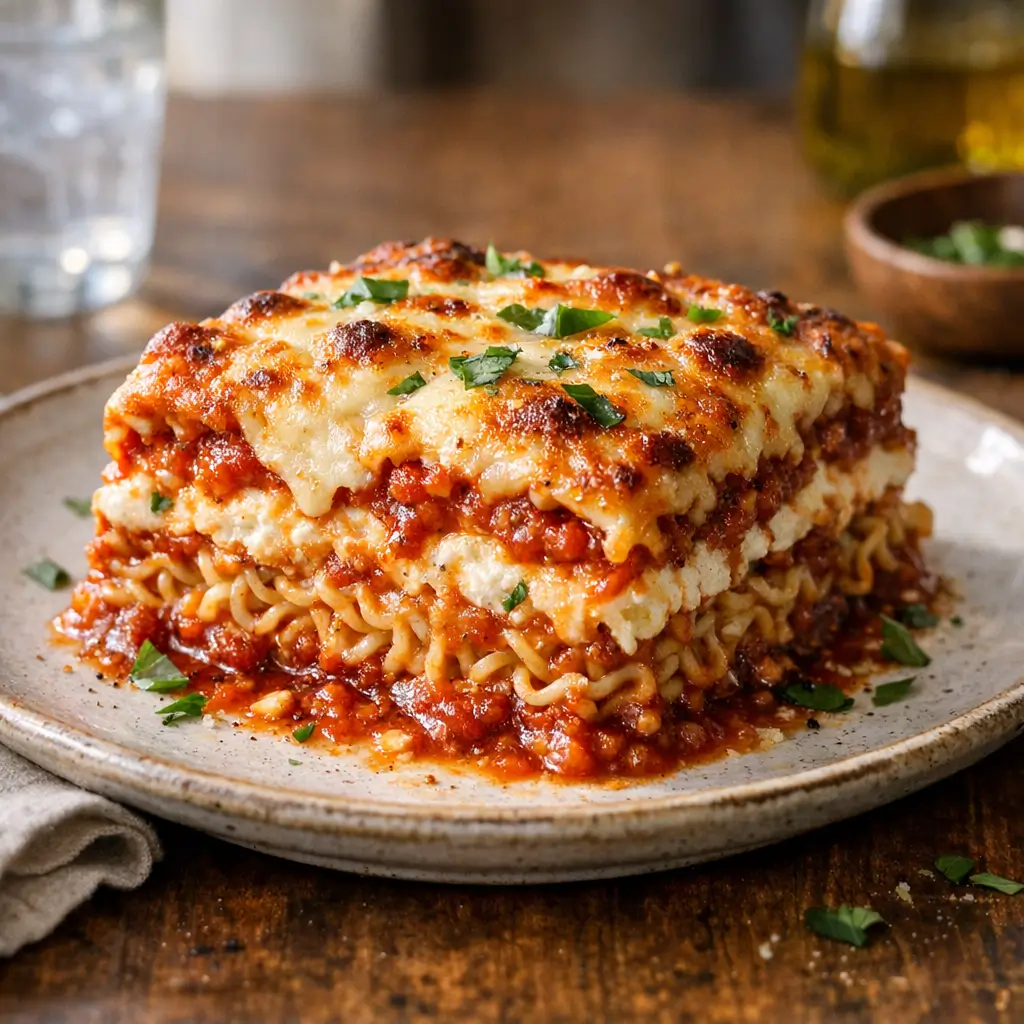
The texture won’t mimic delicate lasagna sheets. Expect springy, softly chewy layers from the ramen, closer to a thick, no‑boil noodle than to restaurant lasagne.
The flavor profile is familiar: bright tomato, creamy ricotta, salty‑nutty Parmesan, and gooey mozzarella. Ramen’s wavy surface traps sauce, so edges get pleasantly caramelized while the middle stays saucy.
Results vary slightly with pan and brand. A dark metal pan browns faster. Thicker marinara (like some premium jars) can run dry unless you add the extra water; very loose sauces may need a few uncovered minutes at the end to evaporate.
WAYS TO CHANGE IT UP
-
Vegetarian/vegan friendly:
-
Keep it vegetarian as written, or make it fully vegan by swapping in plant‑based ricotta and mozzarella. A tofu‑cashew ricotta works well; add nutritional yeast for a Parmesan‑like note. Use vegetable broth instead of water.
-
Trade part of the marinara for a veggie‑packed sauce (finely chopped spinach or mushrooms simmered in the sauce) for more substance.
-
Spicier or milder:
-
For heat, stir red pepper flakes or a spoonful of Calabrian chili in the sauce. Arrabbiata sauce also works.
-
Prefer mild? Choose a sweet basil marinara and skip the garlic powder and pepper flakes. If using any ramen seasoning, start with only 1/4 packet to avoid excess salt.
-
Faster or simplified:
-
Use hotter liquid: bring the water/broth to a simmer before pouring it in to shave a few minutes off the covered bake.
-
Make it single‑serve: assemble in two 20‑ounce oven‑safe bowls with one ramen brick each and bake 25–30 minutes covered, 5–8 minutes uncovered.
-
Microwave jump‑start: assemble as directed, microwave the covered dish for 5–6 minutes to pre‑heat the sauce, then finish in a 425°F (220°C) oven for 8–12 minutes to brown.
Each shortcut trades a bit of deep browning for speed. If you rush the uncovered time, the top will be pale but still melty.
SERVING AND STORAGE
Serve square slices with a green salad, garlicky roasted broccoli, or simple steamed peas. Garlic bread is an obvious—and very welcome—side.
For extra freshness, scatter chopped basil or parsley over the top just before serving. A drizzle of good olive oil also adds sheen and flavor.
Leftovers keep well 3 days in the refrigerator. Reheat, covered, in a 350°F (175°C) oven until hot and melty, 15–20 minutes, or microwave in 60‑second bursts, then broil briefly to re‑crisp the top if desired.
Freezing notes: You can freeze tightly wrapped portions for up to 2 months, but the noodles will soften more after thawing. Reheat from thawed for best texture.
CULTURAL CONTEXT
This dish plays with two staples from different places. Ramen, a wheat‑noodle soup adapted and popularized in Japan during the 20th century, has entire museums dedicated to its history. For a concise look at ramen’s cultural timeline and a 1958 streetscape that marks the invention of instant noodles, see the Shin‑Yokohama Ramen Museum’s overview (official English page).
Lasagna, meanwhile, is a layered pasta bake enjoyed across Italy with regional styles and techniques. For a neutral historical summary that explains how spinach pasta, ragù, and béchamel became associated with the Bolognese version—and how Neapolitan versions lean into ricotta and tomato—read this background from Travel Emilia‑Romagna’s cultural blog (history of lasagne).
Neither background source is a recipe; they’re helpful context if you’re curious about where each component comes from.
COMMON QUESTIONS AND TROUBLESHOOTING
-
The noodles are still hard in the center—what happened?
-
Usually the sauce didn’t fully cover the corners, or the bake wasn’t long enough under foil. Add 2–4 tablespoons hot water around the edges, re‑cover, and bake 5–10 minutes more. Next time, ensure no dry noodle shows before covering.
-
My top browned too fast.
-
Your oven may run hot or the rack was too high. Move the dish to the middle rack and keep it covered a little longer. If needed, lay a sheet of foil loosely over the top for the final minutes.
-
Can I use the ramen seasoning packets?
-
Yes, sparingly. They’re quite salty. Stir 1/4–1/2 packet into the sauce if you like that flavor profile, then taste before adding more salt anywhere else.
-
Ricotta substitute?
-
Small‑curd cottage cheese works 1:1. Drain for 5–10 minutes so it doesn’t water the sauce. Some readers also like mixing half ricotta and half cottage for budget and texture.
-
Sauce amounts: is 24 ounces really enough?
-
It is for a snug 8‑inch dish when you also add 3/4 cup water or broth. If you use a larger pan or your marinara is extra thick, keep an extra 1/2 cup sauce on hand.
-
Can I make it ahead?
-
Assemble up to 24 hours in advance, cover tightly, and refrigerate. Add 5–10 minutes to the covered bake since you’re starting cold. Expect slightly softer noodles.
-
Gluten‑free option?
-
Use gluten‑free instant ramen and check the weight per brick. Some GF bricks are denser; increase added water by 2–3 tablespoons if needed and monitor tenderness.
-
How do I know it’s done without overbaking?
-
Look for bubbling around the edges and a lightly golden top. A skewer should slide through the center with gentle resistance, not a crunch. Resting time is part of the finish.
CONCLUSION
If you try this, leave a comment with what pan you used, your sauce brand, and any tweaks—especially water amounts and bake times that worked in your oven. Your notes help other home cooks hit that sweet spot of saucy, melty comfort on the first go.



Leave a Reply