
Waking up to the smell of baked cinnamon and butter feels like a holiday, which is exactly why this Mother’s Day Brunch French Toast Casserole earns a spot on the menu. It delivers all the comfort of classic French toast with almost no standing at the stove.
If you’re juggling a busy kitchen, start by cutting the bread the night before so it can dry out a bit. If you have kids or guests underfoot, your main job in the morning is just to get the custard mixed and keep an eye on the top so it browns without burning.
This dish shows up at spring brunches, Mother’s Day breakfasts in bed, and holiday buffets where a big, shareable pan makes more sense than individual slices. The texture lands between bread pudding and French toast, with crisp edges, soft centers, and a gently sweet, custardy base. It suits newer cooks who like clear structure and more experienced ones who enjoy tinkering with toppings and mix-ins.
Ingredients
Serves 4–6 (in a 9×13 inch / 23×33 cm baking dish)
For the casserole:
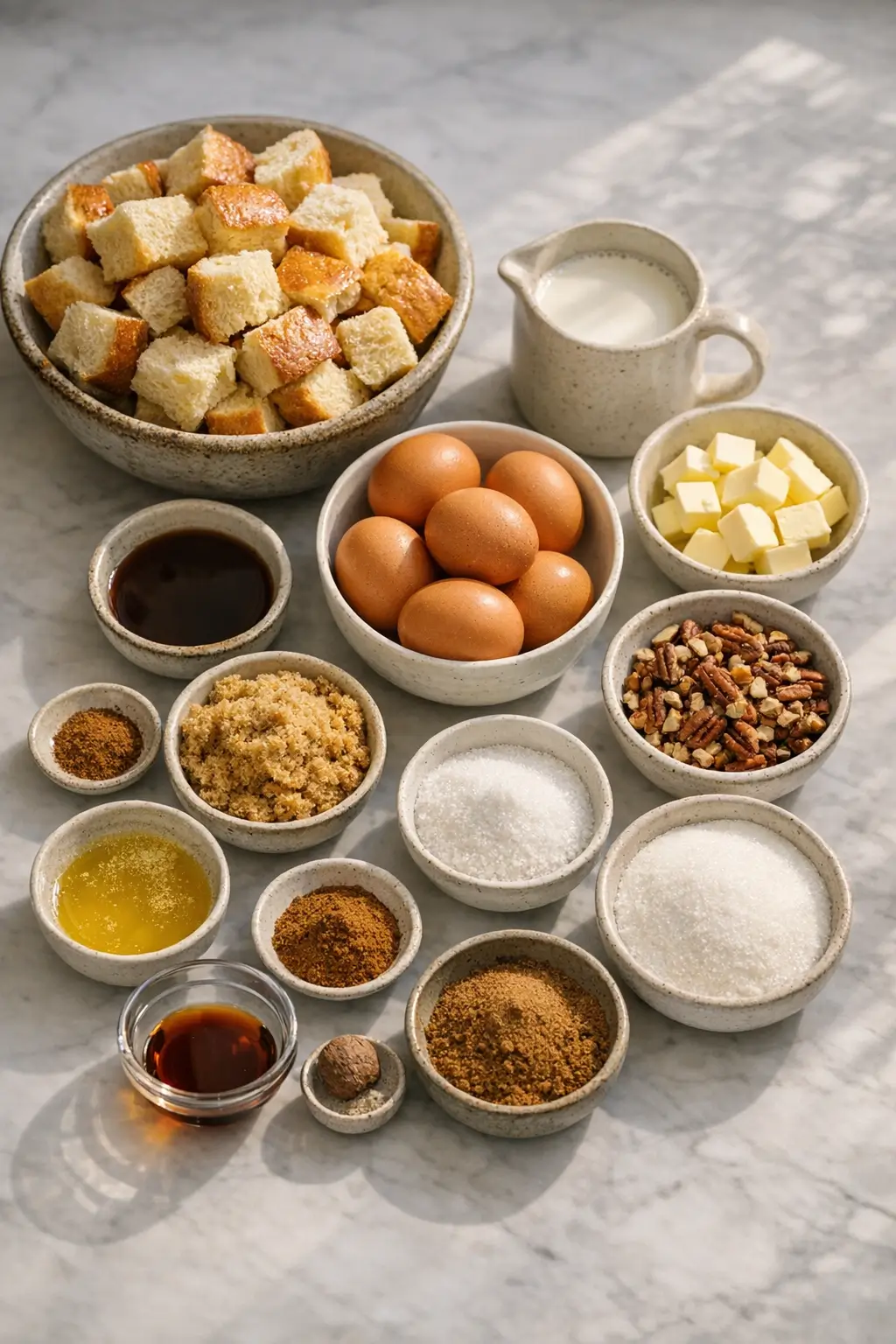
- 400–450 g (about 14–16 oz) day-old brioche or challah, cut into 2.5 cm / 1 inch cubes (rich, eggy bread gives a tender, custardy texture)
- 6 large eggs
- 360 ml (1½ cups) whole milk
- 120 ml (½ cup) heavy cream (or use an extra 120 ml / ½ cup whole milk for a lighter casserole)
- 100 g (½ cup) packed light brown sugar
- 50 g (¼ cup) granulated sugar
- 2 tsp pure vanilla extract
- 1½ tsp ground cinnamon
- ¼ tsp freshly grated nutmeg (optional, adds warmth)
- ¼ tsp fine sea salt (balances sweetness)
- 30 g (2 tbsp) unsalted butter, melted, plus more for greasing the dish
For the cinnamon-sugar topping:
- 50 g (¼ cup) packed light brown sugar
- 25 g (2 tbsp) granulated sugar
- 1 tsp ground cinnamon
- 30 g (2 tbsp) cold unsalted butter, cut into small cubes
- 30 g (¼ cup) chopped pecans or walnuts (optional, for crunch)
To serve (optional but recommended):
- Powdered sugar, for dusting
- Warm maple syrup or honey
- Fresh berries or sliced strawberries
- Whipped cream or vanilla yogurt
Kitchen note: If your bread is very fresh and soft, spread the cubes on a tray and leave them out for 1–2 hours (or in a low oven at 90°C/200°F for 10–15 minutes) so they dry slightly and don’t turn mushy.
Step-by-Step Instructions for Mother’s Day Brunch French Toast Casserole
Prep the dish and bread.
Grease a 9×13 inch (23×33 cm) baking dish lightly with butter.
Add the brioche or challah cubes in an even layer, with some pieces pointing up so you’ll get crisp tips after baking.Mix the custard.
In a large bowl, whisk together the eggs until no streaks of white remain.
Add the milk, cream, brown sugar, granulated sugar, vanilla, cinnamon, nutmeg, and salt.
Whisk until the sugar is dissolved and the spices are evenly distributed.Combine bread and custard.
Slowly pour the custard mixture over the bread cubes, moving the bowl around the pan so every area gets some liquid.
Use a spatula or your hands to gently press the bread down so each cube is at least lightly soaked.
You should see some custard pooling at the bottom but not completely covering the bread.Rest and chill.
Let the casserole sit at room temperature for about 10 minutes so the bread starts absorbing the custard.
Then cover tightly with foil or reusable wrap and refrigerate for at least 4 hours or up to 12 hours.
Overnight works especially well for Mother’s Day morning.Make the cinnamon-sugar topping.
In a small bowl, combine the brown sugar, granulated sugar, and cinnamon.
Add the cold butter cubes and use your fingers or a fork to rub the butter into the sugar mixture until it forms damp, sandy crumbs.
Stir in the chopped nuts if using.
Kitchen note: Keep the topping in the fridge while the casserole chills so the butter stays cold; cold crumbs hold their shape and bake into crisp, distinct bits instead of melting into a flat layer.
Preheat the oven.
When you’re ready to bake, take the casserole out of the refrigerator and remove the cover.
Let it stand on the counter while you preheat the oven to 175°C / 350°F.
This takes the chill off so the casserole bakes more evenly.Add topping before baking.
Sprinkle the cinnamon-sugar mixture evenly over the top of the soaked bread, breaking up any large clumps.
Make sure some of the bread tips are still poking through; those will get nicely toasted.Bake until puffed and set.
Place the dish on the middle rack and bake for 35–45 minutes.
The casserole is done when the top is deeply golden, the edges are bubbling, and the center feels set but slightly jiggly when you nudge the pan.
A knife inserted in the center should come out without wet liquid custard.Adjust for your oven.
If the top browns too quickly before the center looks set, tent the dish loosely with foil and continue baking.
Conversely, if the casserole looks pale after 35 minutes but feels set, move it to a higher rack for the last 5–10 minutes.
Kitchen note: It’s better to go a few minutes longer than to pull this out underbaked; a slightly firmer custard is still delicious, while an underdone center can taste eggy and feel wet rather than creamy.
Rest before serving.
Let the casserole rest for at least 10–15 minutes after baking.
This helps the custard finish setting and makes it easier to cut neat squares.
Dust with powdered sugar just before serving if you like.Serve warm with toppings.
Cut into 6–8 squares and serve warm.
Pass maple syrup, berries, and whipped cream at the table so everyone can finish their slice how they like.
What to Expect
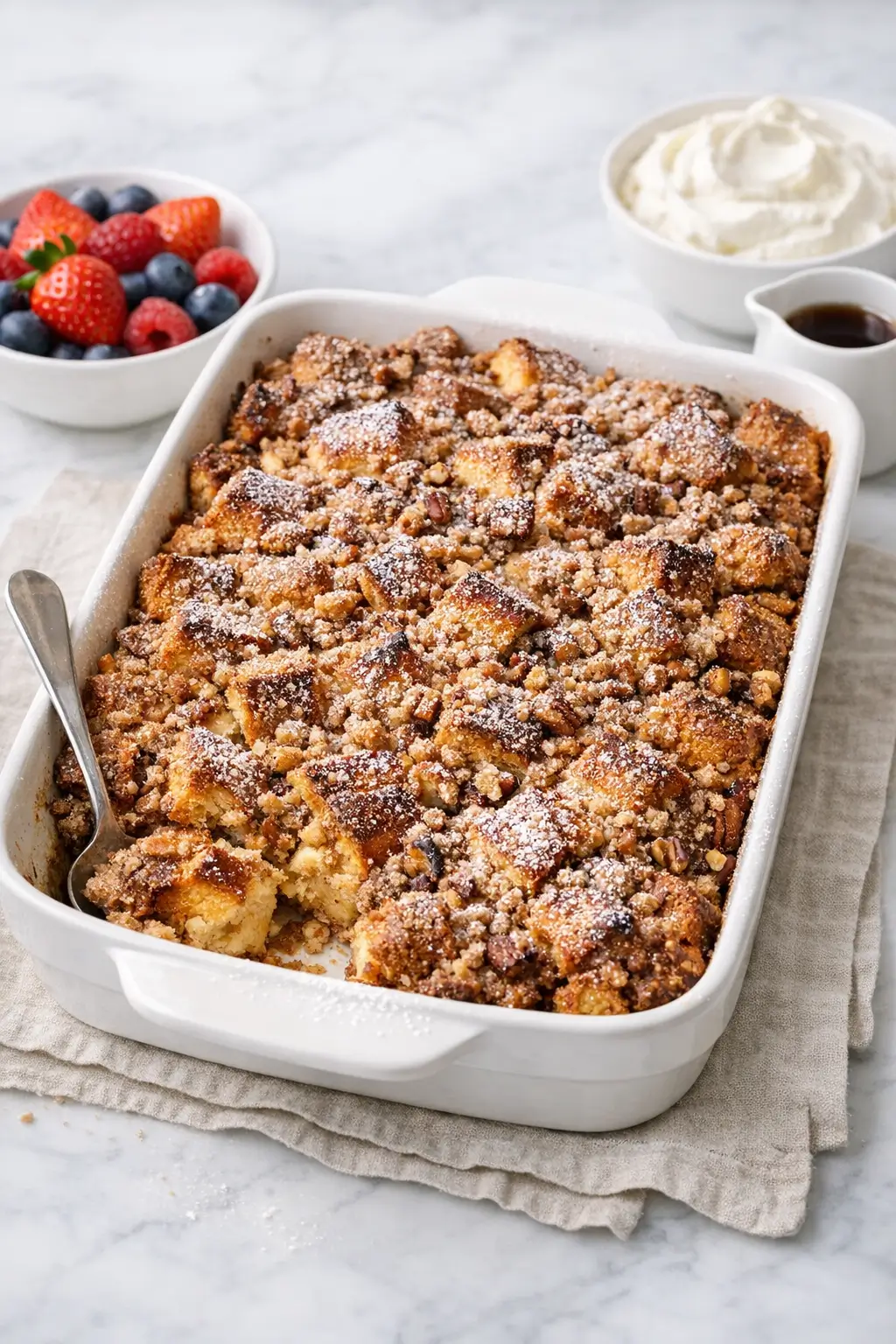
This casserole bakes into a soft, custardy center with crisp, caramelized peaks of bread on top.
The texture sits somewhere between a baked French toast and a simple bread pudding, so expect a spoonable, tender middle rather than firm toast slices.
Flavor-wise, it leans gently sweet rather than dessert-level rich.
Brown sugar and cinnamon give it a warm, “bakery” aroma, while the vanilla and brioche contribute a subtle butteriness.
Maple syrup or fruit on the side lets each person dial the sweetness up or down.
Results can shift slightly with different breads and ovens.
Brioche tends to bake softer and richer, challah stays a touch chewier, and very dry bread will give a more structured, less custardy center.
A darker pan may brown the edges faster than a glass dish, so keep an eye on color the first time you make it.
Kitchen note: If you know your oven runs hot, start checking for doneness around 30 minutes, or lower the temperature by 10–15°C (about 25°F) to avoid a burnt top with an undercooked middle.
Ways to Change It Up
Simple berry version.
Scatter 150–200 g (1–1½ cups) fresh or frozen berries (blueberries, raspberries, or sliced strawberries) over the bread before you pour on the custard.
The fruit softens and collapses slightly in the oven, giving pockets of tartness that balance the sweet topping.
Expect a bit more moisture in the pan, especially if using frozen berries, and add 5 extra minutes of baking time if the center seems loose.Nut-free, kid-friendlier bake.
Omit the nuts from the topping and reduce the cinnamon slightly if your kids prefer milder spice.
You can also cut the brown sugar in the topping by a tablespoon or two and let maple syrup do more of the work on the plate.
The texture stays the same; the flavor is just a touch less intense and more flexible for picky eaters.Lighter dairy option.
Swap the heavy cream for whole milk or unsweetened almond milk, and reduce the brown sugar in the custard to 75 g (⅓ cup).
The casserole will be less rich and slightly less custardy but still soft and satisfying.
This version bakes a bit faster, so begin checking around the 30–32 minute mark.Spiced brunch casserole.
For a more grown-up Mother’s Day flavor profile, add ½ tsp ground cardamom or ½ tsp ground ginger to the custard.
These spices layer well with cinnamon and nutmeg and pair nicely with fresh citrus segments or a berry compote.
Just be aware that cardamom is strong; a little goes a long way.
Serving and Storage
Serve this French toast casserole warm, straight from the baking dish.
For a Mother’s Day spread, it works well alongside a simple fruit salad, crisp bacon or breakfast sausage, or a leafy green salad with a light vinaigrette.
Coffee, tea, and fresh orange juice round out the table without adding extra work.
If you like to set up a DIY topping bar, offer small bowls of berries, sliced bananas, toasted nuts, maple syrup, and a bowl of lightly sweetened whipped cream or vanilla yogurt.
Guests can adjust the sweetness and texture to their own taste, and it makes the casserole feel more like the centerpiece of brunch.
Leftovers keep well.
Cool the casserole completely, then cover the dish tightly or transfer slices to an airtight container.
Refrigerate for up to 3 days.
Reheat individual portions in the microwave for 30–60 seconds, or in a 160°C / 325°F oven for 10–15 minutes until warmed through.
Kitchen note: The topping will soften in the fridge; to bring back some texture, reheat slices in a toaster oven or uncovered in the oven rather than the microwave when you have time.
Cultural Context
French toast, and by extension baked French toast casseroles, grew out of a practical way to use leftover bread.
In many European traditions, cooks soaked day-old bread in a mixture of milk and eggs, then fried it to create a simple, sweet dish.
In France, versions of this are often called “pain perdu,” or “lost bread,” emphasizing its role in preventing waste.
Historical records show related dishes as far back as ancient Rome, and later in medieval European cookbooks, where enriched toasts appeared as ways to make humble ingredients more satisfying.
Over time, the dish traveled and adapted, becoming breakfast or brunch fare in places like North America, often served with butter, syrup, and fruit.
For a concise overview of how French toast developed from “lost bread” into a modern comfort food, see this summary on the history of French toast and this short article about its evolution from simple leftover bread to a popular brunch dish: French toast and its supposed French connection.
Common Questions and Troubleshooting
Why is the center of my casserole soggy?
A slightly soft, custardy center is normal, but it should not be wet.
If it’s soggy, the bread may have been too soft or too fresh, the casserole may not have chilled long enough, or it might be underbaked.
Next time, use day-old brioche or challah, chill for at least 4 hours so the custard can absorb, and bake until a knife in the center comes out without liquid custard.
Can I assemble this the same morning instead of overnight?
You can, but plan at least 30–45 minutes of soak time at room temperature before baking.
The flavor will still be good, though the custard won’t penetrate as deeply, so the texture may be a little drier in the center.
For Mother’s Day, I recommend the overnight chill so the morning is mostly hands-off.
What if I don’t have brioche or challah?
Sturdy white sandwich bread or a soft French loaf can work in a pinch.
Avoid very thin or very soft sliced bread, which tends to fall apart.
If using a leaner bread, you may find the texture a bit less rich, so keep the cream in the custard instead of swapping it for milk.
How sweet is this recipe and can I reduce the sugar?
The casserole is moderately sweet even before syrup.
You can reduce the brown sugar in the custard by 2–3 tablespoons and the topping sugar by about a tablespoon without affecting structure.
Just note that cutting the sugar too aggressively will change the browning and can make the flavor flatter.
Can I freeze leftovers?
Yes.
Cool the casserole completely, cut into portions, and wrap each piece tightly before placing in a freezer-safe container.
Freeze for up to 2 months.
Reheat from frozen at 160°C / 325°F for 20–25 minutes, or thaw in the fridge overnight and warm until heated through.
The texture will be a bit softer than fresh but still very enjoyable.
Conclusion
This make-ahead French toast casserole brings the flavor of a special-occasion brunch into a format that fits real-life mornings, especially on Mother’s Day.
Once you’ve made it once, you can adjust the sweetness, spices, and toppings to suit the people around your table.
If you try it, consider leaving a comment or rating so other home cooks can see how it went in a real kitchen.
Share any tweaks you make—different breads, spice blends, or toppings—so the next reader can start from your experience and make their own version a little smoother.
Mothers Day Brunch French Toast Casserole

Equipment
- 9×13-inch (23×33 cm) baking dish
- Large mixing bowl
- Whisk
- Small bowl
- Fork
- Spatula
- Aluminum foil or reusable wrap
Ingredients
For the casserole
- 400–450 g day-old brioche or challah cut into 2.5 cm / 1-inch cubes
- 6 large eggs
- 360 ml whole milk
- 120 ml heavy cream or use an extra 120 ml / 1/2 cup whole milk for a lighter casserole
- 100 g light brown sugar packed
- 50 g granulated sugar
- 2 tsp pure vanilla extract
- 1 1/2 tsp ground cinnamon
- 1/4 tsp freshly grated nutmeg optional
- 1/4 tsp fine sea salt
- 30 g unsalted butter melted, plus more for greasing the dish
For the cinnamon-sugar topping
- 50 g light brown sugar packed
- 25 g granulated sugar
- 1 tsp ground cinnamon
- 30 g unsalted butter cold, cut into small cubes
- 30 g pecans or walnuts chopped, optional
To serve (optional)
- powdered sugar for dusting
- warm maple syrup or honey
- fresh berries or sliced strawberries
- whipped cream or vanilla yogurt
Instructions
- Prep the dish and bread: Grease a 9×13 inch (23×33 cm) baking dish lightly with butter. Add the brioche or challah cubes in an even layer, with some pieces pointing up so you’ll get crisp tips after baking.
- Mix the custard: In a large bowl, whisk together the eggs until no streaks of white remain. Add the milk, cream, brown sugar, granulated sugar, vanilla, cinnamon, nutmeg, and salt. Whisk until the sugar is dissolved and the spices are evenly distributed.
- Combine bread and custard: Slowly pour the custard mixture over the bread cubes, moving the bowl around the pan so every area gets some liquid. Use a spatula or your hands to gently press the bread down so each cube is at least lightly soaked. You should see some custard pooling at the bottom but not completely covering the bread.
- Rest and chill: Let the casserole sit at room temperature for about 10 minutes, then cover tightly with foil or reusable wrap and refrigerate for at least 4 hours or up to 12 hours.
- Make the cinnamon-sugar topping: In a small bowl, combine the brown sugar, granulated sugar, and cinnamon. Add the cold butter cubes and use your fingers or a fork to rub the butter into the sugar mixture until it forms damp, sandy crumbs. Stir in the chopped nuts if using (keep topping chilled until baking).
- Preheat the oven: Take the casserole out of the refrigerator and remove the cover. Let it stand while you preheat the oven to 175°C / 350°F.
- Add topping before baking: Sprinkle the cinnamon-sugar mixture evenly over the top of the soaked bread, breaking up any large clumps, and leave some bread tips poking through.
- Bake until puffed and set: Bake on the middle rack for 35–45 minutes, until the top is deeply golden, edges are bubbling, and the center feels set but slightly jiggly. A knife inserted in the center should come out without wet liquid custard.
- Adjust for your oven: If the top browns too quickly, tent loosely with foil and continue baking. If it looks pale but feels set, move to a higher rack for the last 5–10 minutes.
- Rest before serving: Let the casserole rest for 10–15 minutes after baking. Dust with powdered sugar just before serving if you like.
- Serve warm: Cut into squares and serve warm with maple syrup, berries, whipped cream, or yogurt as desired.



Leave a Reply