
Strawberry lemonade concentrate is one of those things that makes you feel extremely put‑together even on the days when everyone’s hot, cranky, and you still haven’t figured out dinner. You invest a little time once, stash a few jars or containers, and from then on a cold pitcher is five minutes away. This version sticks to the safe, tested formula of strawberries, lemon juice, and sugar, but I focus on easy equipment and clear cues so you don’t have to babysit a candy thermometer all afternoon. If you’ve got kids underfoot, set them up hulling strawberries at the table and work in batches — it’s messy, but it gets the job done.
Ingredients
Makes about 5–7 pints of concentrate (each pint makes a big pitcher)
For the concentrate
- 2.4 kg / 6 cups strawberry puree (about 1.2–1.4 kg / 8–10 cups whole strawberries before pureeing; hulled)
- Ripe, sweet berries make the concentrate taste like actual strawberries, not pink sugar water.
- 950 ml / 4 cups bottled lemon juice (standard 5% acidity)
- Bottled juice keeps the acidity consistent and is what tested canning recipes are based on.
- 1.2 kg / 6 cups granulated sugar
- This isn’t just for sweetness; it also helps the texture and shelf life.
You can use fresh-squeezed lemon juice for a freezer-only version — it’s brighter, but the acidity isn’t consistent enough for safe canning.
To serve later (per 1 pint / 480 ml jar of concentrate)
- 480–1440 ml / 2–6 cups cold water, sparkling water, or a mix
- Ice
- Extra lemon slices and fresh strawberries, optional, for the pitcher
Step-by-Step Strawberry Lemonade Concentrate
- Prep the jars and equipment (if canning).
- Wash 5–7 pint (480 ml) canning jars, lids, and rings in hot soapy water. Rinse well.
- Set up a water-bath canner or a deep stockpot with a rack, and fill with enough water to cover the jars by at least 2.5 cm / 1 inch. Start heating it so it’s good and hot, just under a simmer, when you’re ready to fill jars.
- Keep jars hot (in the canner water or in a 95–120°C / 200–250°F oven) so they don’t crack when the hot concentrate goes in.
- Prep and puree the strawberries.
- Rinse berries in cool water, drain well, and hull them. Trim off any bruised or moldy spots.
- Puree in a blender or food processor in batches until mostly smooth. A few small bits of berry are fine; big chunks aren’t.
- Measure 6 cups of the puree into a large, heavy-bottomed pot.
- One thing — measure after pureeing, not before. That’s the difference between getting 5 pints and wondering why you suddenly have 8.
- Add lemon juice and sugar.
- Pour 4 cups bottled lemon juice into the pot with the strawberry puree.
- Add 6 cups granulated sugar.
- Stir well before turning on the heat to start dissolving the sugar and keep it from caking on the bottom.
- Heat the concentrate gently.
- Set the pot over medium heat and stir frequently.
- You’re aiming for about 88–90°C / 190°F, which is hot but not boiling. If you don’t have a thermometer, watch for steady steam and small bubbles around the edges that never really break into a full boil.
- Stir until the sugar is fully dissolved and the mixture is uniform and glossy. Don’t walk away; it can scorch if it sits.
- Heads up: it’ll reach temperature faster than you expect because of the sugar content, so start checking early.
- Skim and hold.
- Remove the pot from the heat.
- Skim off any foam on top with a spoon. You don’t have to be obsessive; a little foam won’t hurt anything, but taking the thick layer off makes the jars prettier and easier to fill.
- Keep the concentrate hot while you get ready to fill jars — just pop the lid on the pot.
- Fill jars for shelf-stable canning.
- Working with one hot jar at a time, place it on a towel.
- Ladle hot concentrate into each jar, leaving 6 mm / 1/4 inch headspace at the top.
- Run a non-metallic spatula or a bubble tool around the inside edge to release any trapped air.
- Wipe the rims with a clean, damp cloth (a quick swipe with vinegar on the cloth helps cut any stickiness).
- Center a new lid on each jar, then screw on the ring just fingertip-tight — not wrenched on.
- Process in a water bath.
- Lower the filled jars into the hot water-bath canner. Make sure they’re covered by at least 2.5 cm / 1 inch of water.
- Bring the canner to a vigorous boil with the lid on.
- Once boiling, start timing: 15 minutes for pints at altitudes up to 1,000 ft. For 1,001–6,000 ft, go to 20 minutes; above that, use 25 minutes.
- After the time is up, turn off the heat and let the jars sit in the hot water for 5 minutes to help prevent siphoning.
- Cool and check seals.
- Lift jars straight up out of the canner with a jar lifter and set them on a towel, leaving space between them.
- Don’t tighten the rings or tilt the jars. Just walk away and let them sit undisturbed for 12–24 hours.
- When they’re completely cool, remove the rings, wipe the jars clean, and check the seals. Lids should be concave and not flex when pressed in the center.
- Label with the date.
- Freezer method instead (no canner).
- If you’d rather skip canning, pour the hot concentrate into freezer-safe containers or wide-mouth jars.
- Leave at least 2.5 cm / 1 inch headspace for expansion.
- Cool to room temperature, then chill completely in the fridge before freezing.
- Frozen concentrate keeps well for about 8–10 months.
- To mix a fast pitcher.
- For a classic lemonade, start with 1 part concentrate to 3 parts cold water. So for a pint jar (about 2 cups), add about 6 cups water.
- Taste and adjust — if your strawberries were very sweet, you may want closer to a 1:2 ratio; if you like it lighter, go 1:4.
- Stir well, add ice, and garnish with lemon slices and berries if you’re feeling fancy.
- For sparkling pitchers, use half water and half sparkling water and mix gently so you keep some bubbles.
What to Expect
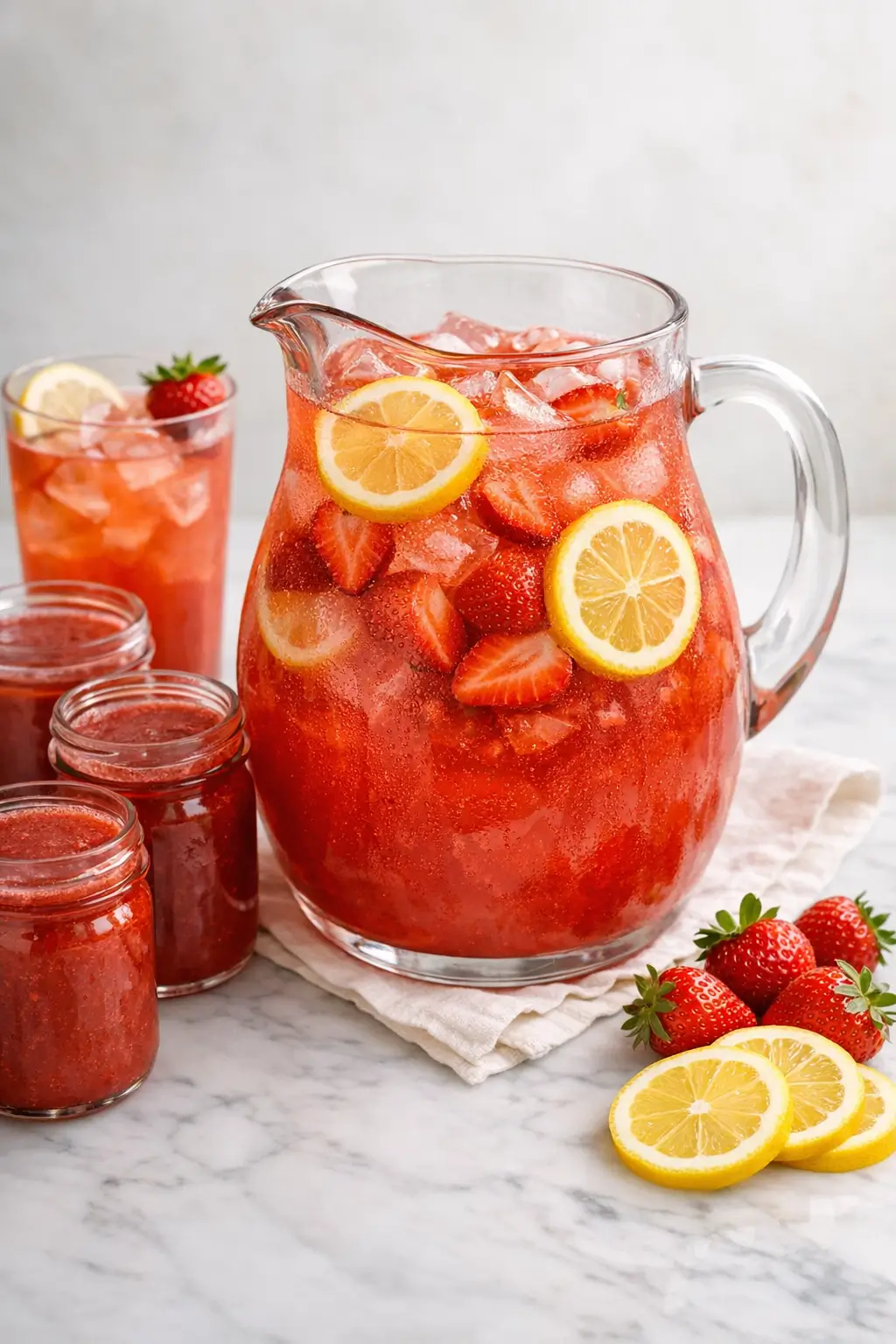
The finished concentrate is a deep rosy red and slightly thick, almost like a loose syrup. Once you mix it with water, you’ll see a cloudy, pink drink with a bit of strawberry pulp that settles slowly at the bottom of the pitcher. The flavor leans tart from the lemon but there’s plenty of sweetness, especially if you stick to the 1:3 ratio. Use less water if you like it punchy, more if you want something you can sip all afternoon without a sugar crash.
Ways to Change It Up
If you just want to tweak the basic recipe a bit, there are a few directions that still play nicely with the safe ratios.
-
A quick freezer-only version: Use fresh-squeezed lemon juice and cut the sugar down to 4–5 cups if you prefer things less sweet. Freeze the concentrate instead of canning. It’ll taste brighter and a little less thick, but you give up the shelf-stable pantry jars.
-
Strawberry limeade: Swap half the bottled lemon juice for bottled lime juice. The color stays similar, but the flavor goes sharper and a bit more “grown up.” I like this one mixed with sparkling water for a not-too-sweet drink.
-
Softer vegan version: Sugar is already vegan in many places, but if you avoid bone-char-filtered sugar, look for organic cane sugar. The method doesn’t change at all; the only real trade-off is that organic sugar can be a bit pricier and may give a slightly more golden tint.
Serving and Storage
For a standard family pitcher, I usually pour one pint jar of concentrate into a 2–2.5 liter / 2–2.5 quart pitcher, then top up with 5–6 cups of cold water and a big handful of ice. If kids are involved, go slightly lighter on the concentrate at first and let them taste — it’s easier to add more than to walk back a too-tart batch. Sparkling water, ginger ale, or tonic water all work, but add them right before serving so you don’t lose the fizz.
Canned strawberry lemonade concentrate keeps in a cool, dark pantry for about 12–18 months. Once you open a jar, store it in the fridge and aim to use it within 7–10 days. Mixed lemonade is best within a day; after that the pulp separates more and the flavor dulls a bit. Re-stir before pouring, but expect the second-day pitchers to be a little flatter and less bright.
Common Questions
Can I use frozen strawberries?
Yes, frozen berries work well here. Thaw them in a colander set over a bowl so the extra water can drain off, then puree and measure your 6 cups of puree. If they’re very pale or bland, the final drink will be milder too; in that case I’d lean toward the 1:2 or 1:2.5 concentrate-to-water ratio when you mix pitchers.
Is it safe to reduce the sugar?
For canned concentrate, I stick to the tested 6 cups sugar. Sugar does more than sweeten; it affects viscosity and how the recipe behaves in the jar. If you want less sugar, make the freezer version instead and drop to 4 cups sugar. Then you can also dilute more aggressively with water in the pitcher.
Do I really need bottled lemon juice for canning?
For water-bath canning, yes. Bottled lemon juice is standardized to a specific acidity, which is what tested canning recipes like the ones from Ball and Bernardin are based on. Fresh lemons can drift less acidic, and you can’t eyeball that. For frozen concentrate, use whichever tastes best to you.
Why did my concentrate separate in the jar?
Strawberry pulp naturally drifts downward while it sits, so you’ll often see a lighter stripe at the top and a denser, darker layer at the bottom. That’s normal. Just give the jar a good shake before opening (or stir well once it’s in the pitcher), and it’ll come back together.
Can I serve this warm?
You can, and it’s actually nice on a chilly, rainy day when cold lemonade sounds all wrong. Warm the concentrate gently with water on the stove until just hot — don’t boil, or you’ll dull the fruit flavor. I like a 1:3 ratio here too, sometimes with a slice of fresh ginger simmered in for a few minutes.
I first made this strawberry lemonade concentrate after a pick-your-own trip where I overdid it on berries, and it’s been a repeat project every spring since. If you try a sparkling version or sneak a splash into cocktails, tell me what you mix it with — I’m always looking for new pitcher ideas when the weather turns hot again.

Strawberry Lemonade Concentrate for Easy Pitchers

Equipment
- Blender or food processor
- Large heavy-bottomed pot
- Spoon (for skimming foam)
- Ladle
- Canning jars (pint/480 ml), lids, and rings
- Water-bath canner or deep stockpot with rack
- Jar lifter
- Non-metallic spatula or bubble tool
- Clean cloth (and vinegar, optional)
Ingredients
For the concentrate
- 6 cups strawberry purée from about 8–10 cups (1.2–1.4 kg) whole strawberries, hulled; measure after puréeing (about 2.4 kg purée listed in post)
- 4 cups bottled lemon juice (standard 5% acidity)
- 6 cups granulated sugar
To serve later (per 1 pint / 480 ml jar of concentrate)
- 2–6 cups cold water, sparkling water, or a mix
- ice
- lemon slices and fresh strawberries optional, for the pitcher
Instructions
- Prep the jars and equipment (if canning): Wash 5–7 pint (480 ml) canning jars, lids, and rings. Set up a water-bath canner (or deep stockpot with rack) and heat enough water to cover jars by at least 2.5 cm/1 inch. Keep jars hot (in canner water or a 95–120°C/200–250°F oven) so they don’t crack when filled.
- Prep and purée the strawberries: Rinse, drain, and hull berries; trim any bruised spots. Purée in batches until mostly smooth. Measure 6 cups strawberry purée into a large heavy-bottomed pot (measure after puréeing).
- Add lemon juice and sugar: Add 4 cups bottled lemon juice and 6 cups granulated sugar to the pot. Stir well before turning on the heat to start dissolving the sugar.
- Heat the concentrate gently: Heat over medium, stirring frequently, until hot but not boiling (about 88–90°C/190°F). Look for steady steam and small bubbles around the edges. Stir until the sugar is fully dissolved and the mixture is uniform and glossy.
- Skim and hold: Remove from heat and skim off foam. Keep the concentrate hot while you prepare to fill jars (cover the pot).
- Fill jars (for shelf-stable canning): Working with one hot jar at a time, ladle hot concentrate into jars leaving 6 mm (1/4 inch) headspace. Release bubbles with a non-metallic tool, wipe rims (vinegar helps), apply lids, and screw rings on fingertip-tight.
- Process in a water bath: Lower filled jars into the canner, ensuring at least 2.5 cm/1 inch of water covers them. Bring to a vigorous boil and process pints 15 minutes (up to 1,000 ft; adjust to 20 minutes for 1,001–6,000 ft and 25 minutes above that). Turn off heat and let jars sit 5 minutes in the hot water.
- Cool and check seals: Remove jars with a jar lifter and cool undisturbed 12–24 hours. Remove rings, wipe jars, and check seals (lids should be concave and not flex). Label and store.
- Freezer method (instead of canning): Pour hot concentrate into freezer-safe containers or wide-mouth jars, leaving at least 2.5 cm/1 inch headspace. Cool to room temperature, chill completely, then freeze (keeps about 8–10 months).
- To mix a fast pitcher: Start with 1 part concentrate to 3 parts cold water (about 6 cups water per 1 pint/2-cup jar). Adjust to taste (roughly 1:2 to 1:4). Stir, add ice, and garnish; for sparkling pitchers, use part sparkling water and mix gently.



Leave a Reply