
If you like the idea of sushi night but aren’t excited about buying raw fish, a chicken sushi roll is a practical middle ground. You still get seasoned sushi rice, nori, and that same satisfying bite, but the filling is cooked, saucy chicken instead of seafood. It’s familiar enough for cautious eaters and kids, but still feels like a fun project.
On a busy weeknight, start your rice first, then make the teriyaki chicken while it cooks so everything’s ready when you lay out the nori. If you’re wrangling kids or sharing a small counter, set up a simple rolling station and work one roll at a time so nothing feels chaotic.
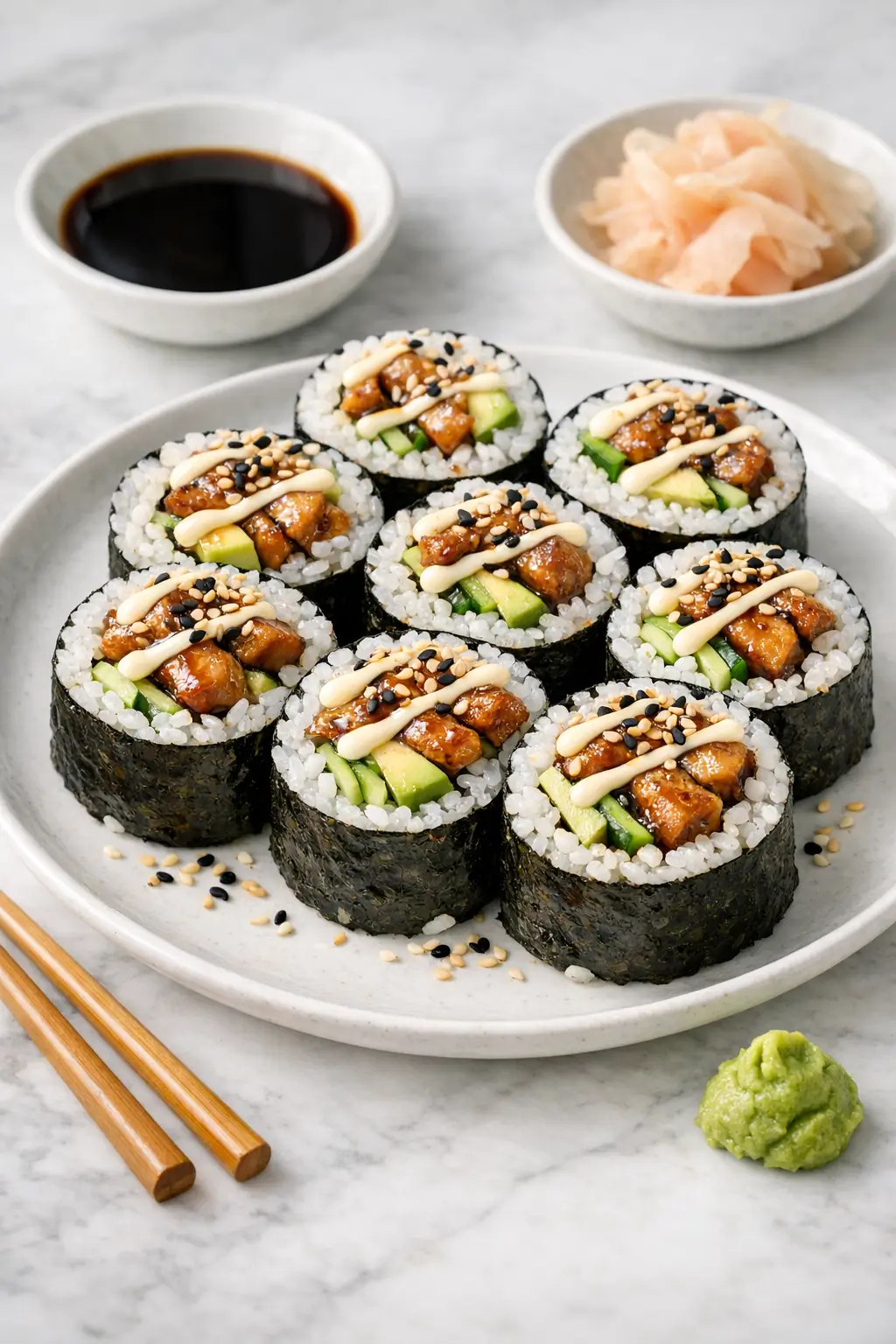
Expect tender teriyaki chicken, creamy avocado, and crisp cucumber wrapped in slightly warm, gently vinegared rice. The rolls slice cleanly if you chill them briefly and use a sharp, damp knife.
Ingredients
For the sushi rice
- 1 1/2 cups (300 g) sushi rice or short-grain Japanese rice – the base of the rolls
- 1 3/4 cups (420 ml) water – for cooking the rice (adjust per package if needed)
- 3 tablespoons (45 ml) rice vinegar – seasons the rice
- 1 1/2 tablespoons (18 g) granulated sugar – balances the vinegar
- 3/4 teaspoon fine sea salt – enhances flavor
For the teriyaki chicken filling
- 10 oz (280 g) boneless, skinless chicken thighs or breast – thighs stay a bit juicier
- 1 tablespoon neutral oil (canola, vegetable, or grapeseed) – for pan-searing
- 2 tablespoons (30 ml) soy sauce – base of the teriyaki-style sauce
- 2 tablespoons (30 ml) mirin – adds sweetness and gloss
- 1 tablespoon (15 ml) sake or dry white wine – depth of flavor; use water or extra mirin if avoiding alcohol
- 1 tablespoon (12 g) sugar or honey – to round out the sauce
For assembling the rolls
- 4 full sheets nori (dried seaweed) – standard sushi-size sheets
- 1 small avocado, ripe but still firm, sliced into strips – creamy contrast
- 1/2 medium cucumber, seeded and cut into thin matchsticks – crunch and freshness
- 2–3 tablespoons toasted sesame seeds – nutty aroma; black or white both work
- Japanese mayonnaise (Kewpie) or regular mayo, to drizzle (optional) – richness and moisture
To serve
- Soy sauce – for dipping
- Pickled ginger – optional palate cleanser
- Wasabi – optional heat
Kitchen note: Sushi rice sticks to everything. Keep a small bowl of cold water by your board and dip your fingers before handling the rice or shaping rolls.
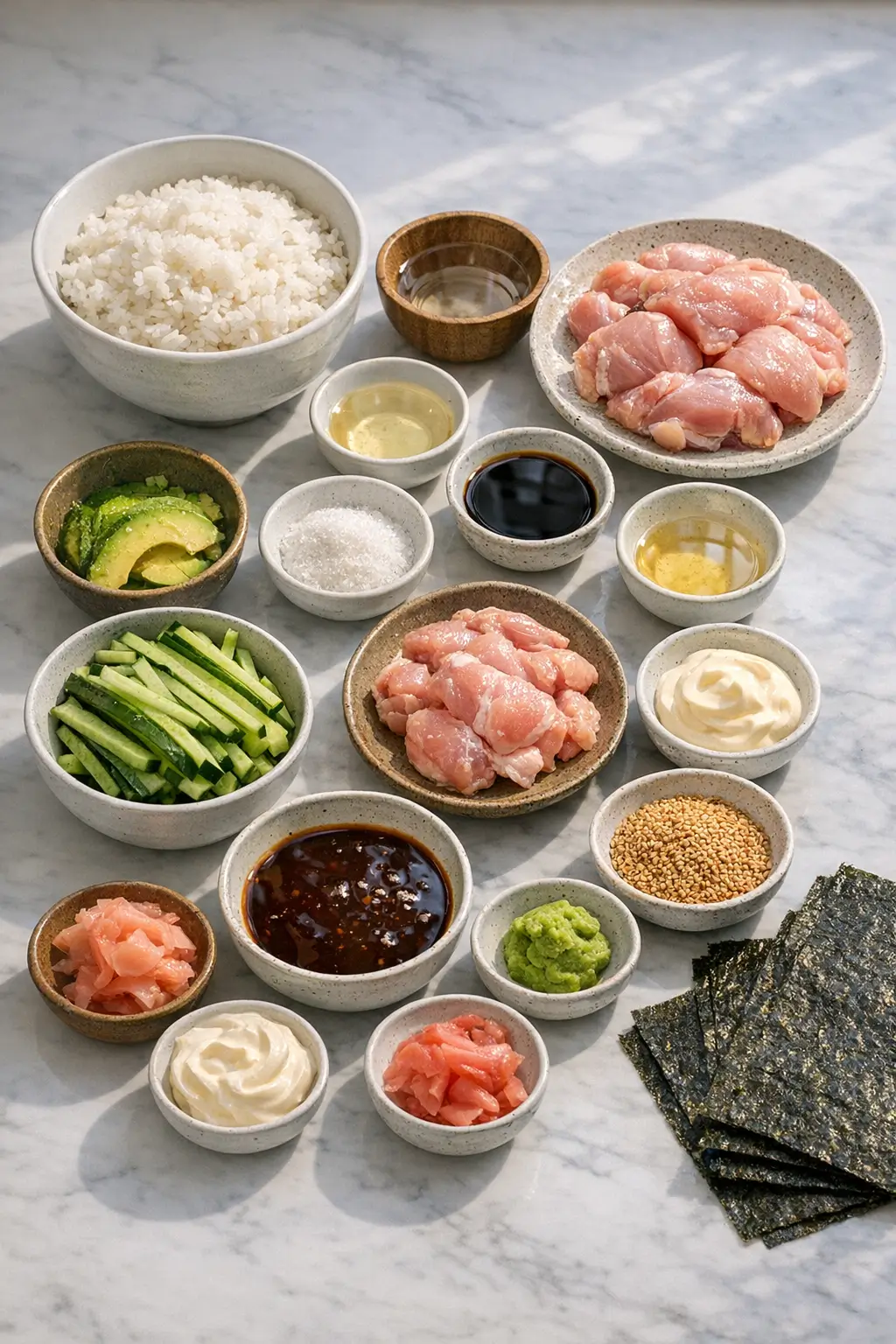
Step-by-Step Instructions for Chicken Sushi Roll
-
Cook and season the rice.
Rinse the sushi rice in several changes of cold water, swirling with your hand, until the water runs mostly clear. Drain well in a sieve.
Add the rinsed rice and 1 3/4 cups (420 ml) water to a saucepan. Bring to a gentle boil, cover, then reduce heat to low and cook for 12–15 minutes, or per your package directions, until the water is absorbed. -
Steam and cool the rice.
Turn off the heat and let the rice sit, covered, for 10 minutes to steam. Meanwhile, mix the rice vinegar, sugar, and salt in a small bowl until dissolved.
Transfer the hot rice to a wide, shallow bowl or baking dish. Drizzle the vinegar mixture over the rice and gently “cut” and fold it in with a spatula or rice paddle. Spread the rice out slightly so it cools to just warm room temperature. -
Prep the chicken.
While the rice cooks and cools, trim any excess fat from the chicken and cut into long strips about 1/2 inch (1.25 cm) wide. You can also leave the pieces whole and slice after cooking if that’s easier to manage.
In a small bowl, combine soy sauce, mirin, sake (or substitute), and sugar or honey. Stir until the sugar dissolves. -
Cook the teriyaki chicken.
Heat the oil in a medium skillet over medium heat. Add the chicken in a single layer and cook for 3–4 minutes on the first side, until lightly browned.
Flip the chicken and cook another 2–3 minutes, then pour in the teriyaki mixture. Let it bubble and simmer, turning the chicken occasionally, until the pieces are cooked through and the sauce thickens and looks glossy, 4–6 minutes. -
Slice and cool the chicken.
Transfer the chicken to a plate, spooning a little sauce over the top. Let it cool until warm, not hot.
If you cooked whole pieces, slice them into long strips that will fit across the width of your nori. You want them thin enough to roll easily but generous enough that you’ll taste the chicken in every bite.
Kitchen note: If the teriyaki sauce reduces too fast and starts to look sticky or smell a bit scorched, splash in a tablespoon of water, lower the heat, and swirl the pan to loosen it.
-
Prep your vegetables and rolling station.
Slice the avocado and cucumber into thin, even strips. Keep the avocado covered with plastic wrap or lightly brushed with lemon juice to prevent browning if it will sit.
Set out your sushi mat (or a clean kitchen towel wrapped in plastic), nori sheets, bowl of water, cooled rice, chicken, avocado, cucumber, and sesame seeds. -
Lay out the nori and rice.
Place one sheet of nori, shiny side down, on the mat with a short edge closest to you.
Wet your fingers, then take about 3/4 cup of sushi rice and gently spread it over the nori in a thin, even layer, leaving a 3/4-inch (2 cm) strip of bare nori at the top edge. Avoid pressing the rice into a paste; think gentle patting. -
Add the fillings.
Lay 2–3 strips of teriyaki chicken horizontally across the rice, about 1 inch (2.5 cm) up from the bottom edge.
Top with a few avocado slices and a small handful of cucumber matchsticks. Drizzle with a thin line of Japanese mayonnaise if using, and sprinkle with a pinch of sesame seeds. -
Roll it up.
Lift the edge of the mat closest to you with your thumbs, holding the fillings lightly in place with your fingers. Roll the nori over the filling until the bottom edge meets the rice.
Use your fingers to tuck the filling in snugly, then continue rolling away from you, pulling the mat back slightly as you go, until you reach the bare strip of nori.
Wet the bare edge lightly with water, then finish rolling to seal. -
Shape and rest the roll.
Use the mat to gently press and shape the roll into a firm cylinder, applying even pressure along its length.
Set the roll aside seam-side down for a few minutes while you repeat with remaining ingredients. This resting time helps the nori hydrate and the roll hold its shape. -
Slice the rolls.
When all rolls are made, use a very sharp knife to slice each roll into 8 pieces.
Dip the blade in water and wipe it on a damp towel between cuts to prevent sticking and tearing. -
Garnish and serve.
Arrange the pieces cut-side up on a platter. Sprinkle with extra sesame seeds.
Serve with soy sauce, pickled ginger, and wasabi on the side so everyone can season to their own taste.
Kitchen note: If your rolls insist on falling apart, you may be overfilling them or not leaving enough bare nori to seal. For your next roll, use slightly less filling and press more firmly with the mat to help everything compress.
What to Expect
This chicken sushi roll gives you the familiar chew of seasoned sushi rice with a filling that feels closer to a teriyaki chicken rice bowl.
The chicken is tender and glossy from the sauce, not crispy, so don’t expect a fried cutlet texture.
Avocado adds creaminess, while cucumber keeps each bite bright and crisp.
The nori should be pleasantly chewy—not brittle—once it has had a few minutes in contact with the warm rice.
Flavors lean savory-sweet from the soy, mirin, and sugar, with enough salt to keep it from feeling like a dessert.
Using Japanese mayonnaise or a splash of extra teriyaki sauce on top adds richness; without it, the rolls taste cleaner and lighter.
Home stoves and rice brands vary, so your rice may cook slightly faster or slower.
If the rice seems too firm after resting, sprinkle a tablespoon or two of hot water over it, cover, and let it steam for a few more minutes before seasoning.
Kitchen note: If your kitchen is very dry or cold, cover finished rolls loosely with plastic wrap while you slice to prevent the rice from drying out and cracking.
Ways to Change It Up
Make it crisp.
For something closer to a restaurant chicken katsu roll, bread thin chicken cutlets in flour, beaten egg, and panko, then shallow-fry until golden before slicing into strips.
Use these instead of the saucy teriyaki chicken and drizzle with tonkatsu sauce and Japanese mayonnaise.
Speed it up with rotisserie chicken.
If you’re short on time, shred about 2 cups (250 g) cooked rotisserie chicken and warm it briefly in a pan with a quick sauce of soy, mirin, and a bit of sugar instead of cooking raw chicken from scratch.
It won’t have quite the same glazed texture but still makes a satisfying weeknight roll.
Adjust the heat.
For a spicier version, mix a spoonful of sriracha or chili crisp into the mayo before drizzling inside the roll, or serve the spicy mayo on top.
To make it milder for kids, skip the wasabi and go light on the sauce so the sweetness of the mirin and sugar is more prominent.
Make it dairy-free or egg-free.
Simply leave out the mayonnaise entirely or swap in an egg-free vegan mayo.
The roll will rely more on the teriyaki sauce for moisture, so be generous with that.
Bulk up the vegetables.
Add thin strips of carrot, blanched green beans, or lettuce for more color and crunch.
Just stay mindful of the total volume of filling so the rolls still close comfortably.
Serving and Storage
Chicken sushi rolls make a relaxed dinner, but they’re also ideal in lunch boxes since everything inside is cooked.
Pack the soy sauce, wasabi, and pickled ginger on the side to keep the rice from getting overly salty or soggy.
For a simple meal, pair these rolls with a light soup such as Pea and Mint Soup That Tastes Like Spring or a crunchy salad like Iceberg Wedge Salad With Green Goddess Ease.
Steamed edamame, miso soup, or a quick cucumber salad also fit neatly alongside.
Leftover rolls are best eaten within 24 hours.
Store them covered in the refrigerator and bring to room temperature for 15–20 minutes before serving so the rice isn’t ice-cold and hard.
The avocado may darken slightly but will still be safe to eat.
If you plan to make rolls specifically for the next day, go lighter on the avocado and heavier on cucumber and chicken, which hold better.
Avoid microwaving the rolls, which tends to toughen the nori and over-soften the rice.
Cultural Context
Sushi developed in Japan as a way to enjoy vinegared rice with preserved or fresh seafood and vegetables.
Over time, many regions adapted the idea, and in North America especially, rolls with cooked fillings like tempura shrimp or grilled eel have become common.
Rolls using chicken, such as teriyaki or katsu versions, follow that same fusion path: they borrow the format of makizushi while using a familiar protein that’s easy to source and fully cooked.
This makes sushi-style meals more approachable for people who avoid raw fish.
For more background on how sushi evolved and spread globally, the entry on sushi from the Oxford Research Encyclopedias offers a useful overview, and the Asia Society provides accessible introductions to Japanese food culture and dining customs: historical perspectives on sushi and Japanese foodways and Japanese food and drink background.
Common Questions and Troubleshooting
My rice turned out mushy. Can I still use it?
If the rice is very soft but not completely broken down, you can still use it, but spread it in a thinner layer on the nori and be extra gentle when rolling.
Next time, try reducing the water slightly and avoid stirring the rice too much after cooking, which can mash the grains.
The rolls won’t seal and keep popping open. What went wrong?
Most often, there’s either too much filling or the bare strip of nori at the top edge wasn’t moistened enough.
Use a bit less chicken and avocado, and run a wet fingertip along that top strip so it becomes slightly tacky before you complete the roll.
Can I make chicken sushi rolls ahead for a party?
Yes, but for the best texture, roll and slice them no more than 4–6 hours before serving.
Keep them covered with a barely damp towel or plastic wrap in the refrigerator, then transfer to a serving platter just before guests arrive.
Is it safe to pack these in a lunchbox?
Because the filling is cooked chicken, these rolls are generally safer than raw-fish sushi, but they still need to stay cool.
Use an insulated lunch bag with an ice pack, and aim to eat them within about 4–5 hours of packing.
What can I use instead of mirin?
You can substitute an equal amount of additional soy sauce plus a teaspoon or two of sugar, or use a mild white wine with a bit of sugar.
The flavor will be slightly less rounded but still works well in a home setting.
Can I bake the chicken instead of pan-cooking it?
You can roast seasoned chicken strips at 400°F (200°C) until cooked through, then toss them in a small saucepan with the teriyaki mixture and simmer briefly to glaze.
This approach is helpful if you’re already using the oven for something else.
Conclusion
Chicken sushi rolls are a flexible way to bring sushi-night energy into a home kitchen without hunting down sashimi-grade fish.
Once you’ve made them once or twice, the flow of cooking rice, glazing chicken, and rolling everything together becomes pleasantly routine.
If you try this version, I’d appreciate it if you leave a comment or rating with what worked for you.
Share any tweaks—extra vegetables, crispy chicken, spicier sauce—so other home cooks can benefit from your experiments too.

Chicken Sushi Roll with Teriyaki and Avocado Ease

Equipment
- Saucepan with lid
- Fine-mesh sieve
- Wide shallow bowl or baking dish
- Small bowl
- Spatula or rice paddle
- Medium skillet
- Cutting board
- Sharp knife
- Bamboo sushi mat (makisu) or clean kitchen towel wrapped in plastic
Ingredients
For the sushi rice
- 1 1/2 cups sushi rice or short-grain Japanese rice about 300 g
- 1 3/4 cups water about 420 ml
- 3 tablespoons rice vinegar about 45 ml
- 1 1/2 tablespoons granulated sugar about 18 g
- 3/4 teaspoon fine sea salt
For the teriyaki chicken filling
- 10 oz boneless, skinless chicken thighs or breast about 280 g
- 1 tablespoon neutral oil such as canola, vegetable, or grapeseed
- 2 tablespoons soy sauce about 30 ml
- 2 tablespoons mirin about 30 ml
- 1 tablespoon sake or dry white wine about 15 ml; substitute water or extra mirin if avoiding alcohol
- 1 tablespoon sugar or honey about 12 g
For assembling the rolls
- 4 full sheets nori (dried seaweed) standard sushi-size sheets
- 1 small avocado ripe but still firm, sliced into strips
- 1/2 medium cucumber seeded and cut into thin matchsticks
- 2–3 tablespoons toasted sesame seeds black or white
- Japanese mayonnaise (Kewpie) or regular mayonnaise optional, to drizzle
To serve
- soy sauce for dipping
- pickled ginger optional
- wasabi optional
Instructions
- Cook and season the rice: Rinse sushi rice in several changes of cold water until mostly clear; drain well. Add rice and 1 3/4 cups (420 ml) water to a saucepan. Bring to a gentle boil, cover, reduce heat to low, and cook 12–15 minutes (or per package) until water is absorbed.
- Steam and cool the rice: Turn off heat and let rice sit covered for 10 minutes. Mix rice vinegar, sugar, and salt until dissolved. Transfer hot rice to a wide shallow bowl or baking dish, drizzle over vinegar mixture, and gently cut/fold with a spatula or rice paddle. Spread rice slightly to cool to just warm room temperature.
- Prep the chicken: Trim excess fat and cut chicken into long strips about 1/2 inch (1.25 cm) wide (or cook whole and slice later). In a small bowl, combine soy sauce, mirin, sake (or substitute), and sugar or honey; stir until dissolved.
- Cook the teriyaki chicken: Heat oil in a medium skillet over medium heat. Add chicken in a single layer and cook 3–4 minutes on the first side until lightly browned. Flip and cook 2–3 minutes, then add teriyaki mixture and simmer, turning occasionally, until chicken is cooked through and sauce is glossy and thickened, 4–6 minutes.
- Slice and cool the chicken: Transfer chicken to a plate and spoon a little sauce over the top. Cool until warm, not hot. If cooked whole, slice into long strips that will fit across the nori.
- Prep vegetables and station: Slice avocado and cucumber into thin even strips (cover avocado or brush with lemon juice if holding). Set out sushi mat (or towel wrapped in plastic), nori, a bowl of water, cooled rice, chicken, avocado, cucumber, and sesame seeds.
- Lay out nori and rice: Place 1 sheet of nori shiny-side down on the mat with a short edge closest to you. Wet fingers and spread about 3/4 cup rice in a thin even layer, leaving a 3/4-inch (2 cm) bare strip at the top edge.
- Add fillings: Lay 2–3 strips chicken across the rice about 1 inch (2.5 cm) from the bottom edge. Add a few avocado slices and a small handful of cucumber. Drizzle mayonnaise if using and sprinkle with a pinch of sesame seeds.
- Roll: Lift the mat edge closest to you and roll nori over filling until the bottom edge meets the rice. Tuck snugly, then continue rolling to the bare strip. Lightly wet the bare edge and finish rolling to seal.
- Shape and rest: Use the mat to gently press and shape into a firm cylinder. Set seam-side down a few minutes; repeat with remaining ingredients.
- Slice: With a very sharp knife, slice each roll into 8 pieces. Dip blade in water and wipe on a damp towel between cuts to prevent sticking.
- Garnish and serve: Arrange pieces cut-side up and sprinkle with extra sesame seeds. Serve with soy sauce, pickled ginger, and wasabi if desired.



Leave a Reply