
A classic cheesecake with berry sauce feels right at home on a July Fourth table: rich but not heavy, familiar yet special, and easy to make ahead so you’re not baking during the heat of the day. This version leans on a traditional graham cracker crust and a smooth, vanilla-forward filling, topped with a glossy red-and-blue berry sauce that fits the holiday without requiring any fussy decorating.
If you’re juggling burgers on the grill and kids running through the yard, start the cheesecake in the morning so it has plenty of time to cool, and prep the berry sauce while it bakes. If your kitchen runs hot, plan a clear space in the fridge before you begin so the cheesecake can chill undisturbed.
Ingredients
Makes one 9-inch cheesecake (10–12 modest slices)
For the graham cracker crust
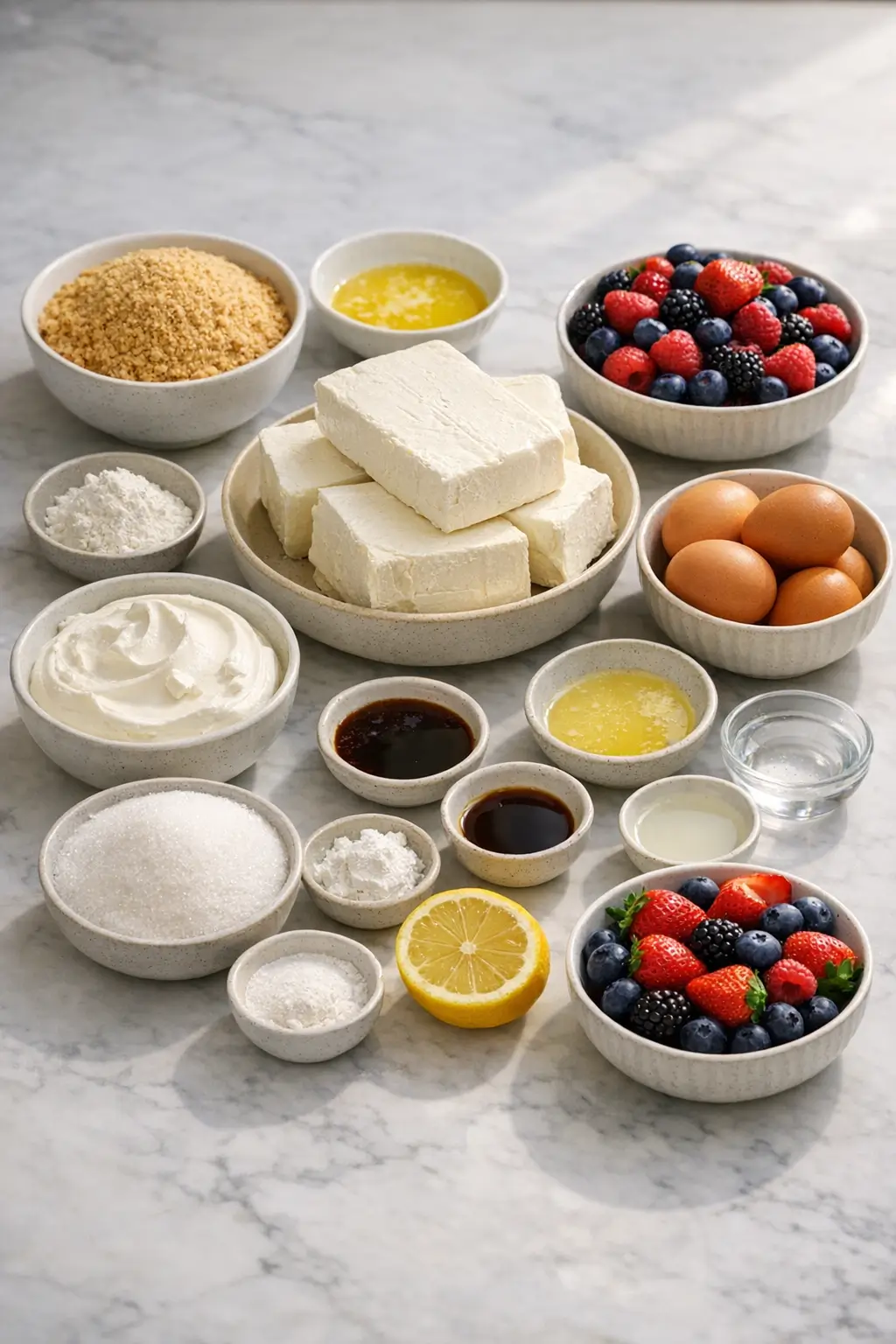
- 200 g / 2 cups graham cracker crumbs (about 14 full crackers), finely crushed – classic cheesecake base
- 75 g / 6 Tbsp unsalted butter, melted
- 50 g / 1/4 cup granulated sugar
- 1/4 tsp fine sea salt (omit if using salted butter)
For the cheesecake filling
- 910 g / 2 lbs / four 8-oz blocks full-fat cream cheese, at room temperature
- 200 g / 1 cup granulated sugar
- 20 g / 2 Tbsp all-purpose flour – helps prevent cracking slightly
- 1/4 tsp fine sea salt
- 240 g / 1 cup full-fat sour cream, at room temperature
- 5 large eggs, at room temperature
- 10 ml / 2 tsp pure vanilla extract
- 5 ml / 1 tsp fresh lemon juice – gently brightens the flavor (or use 1/2 tsp lemon zest)
Kitchen note: Room-temperature dairy is non‑negotiable here. Cold cream cheese or eggs create a lumpy batter and encourage overmixing, which can lead to a dense or cracked cheesecake.
For the mixed berry sauce
- 300 g / about 2 cups mixed berries, fresh or frozen (such as strawberries, blueberries, raspberries, and/or blackberries)
- 100 g / 1/2 cup granulated sugar (adjust to taste depending on berry sweetness)
- 120 ml / 1/2 cup water
- 10 ml / 2 tsp fresh lemon juice
- 8 g / 1 Tbsp cornstarch
- 15 ml / 1 Tbsp cold water (for slurry)
- Pinch of fine sea salt
To finish and serve
- Extra fresh berries for topping (strawberries and blueberries are especially fitting for July Fourth)
- Lightly sweetened whipped cream (optional)
Step-by-Step Instructions for Classic Cheesecake with Berry Sauce
1. Prepare your pan and oven
- Place a rack in the lower-middle of the oven and preheat to 325°F / 165°C.
- Wrap the outside of a 9-inch (23 cm) springform pan tightly with two layers of heavy-duty aluminum foil, covering the bottom and up the sides to prevent water from seeping in.
- Lightly grease the inside of the pan with butter or nonstick spray.
- Set a large roasting pan (or deep baking dish) on the oven rack; this will hold the water bath.
2. Make and bake the crust
- In a mixing bowl, combine the graham cracker crumbs, sugar, and salt.
- Pour in the melted butter and stir with a fork until the mixture looks like damp sand and holds together when squeezed.
- Tip the crumbs into the springform pan. Press firmly over the bottom and slightly up the sides (about 2.5 cm / 1 inch). Use the bottom of a measuring cup to compact it evenly.
- Bake the crust for 10 minutes, then remove and set on a rack to cool slightly while you prepare the filling.
Kitchen note: If the crust mixture feels greasy or won’t hold together, your crumbs may be too coarse. Crush them a bit finer and press again so you don’t end up with a crumbly base that falls apart when sliced.
3. Make the cheesecake filling
- Reduce the oven temperature to 300°F / 150°C.
- In a large bowl or stand mixer fitted with the paddle attachment, beat the cream cheese on medium-low speed for 2–3 minutes, scraping down the bowl as needed, until completely smooth and no lumps remain.
- Add the sugar, flour, and salt. Mix on low to medium-low just until incorporated and smooth, scraping the bowl.
- Add the sour cream and mix on low speed until combined and silky.
- In a small bowl, lightly beat the eggs just to break up the yolks.
- With the mixer on low, add the eggs in two or three additions, mixing only until each addition is just blended. Avoid whipping air into the batter.
- Add the vanilla and lemon juice and mix briefly to combine.
- Tap the bowl on the counter a few times to release any large air bubbles.
4. Fill the pan and set up the water bath
- Pour the filling over the baked crust in the springform pan. Smooth the top with an offset spatula.
- Bring a kettle or large pot of water to a boil.
- Carefully place the foil-wrapped springform pan into the roasting pan already in the oven, or set it in the roasting pan on your counter and then transfer.
- Pour the hot water into the roasting pan, around the cheesecake, until it reaches about halfway up the sides of the springform pan.
Kitchen note: A water bath helps the cheesecake bake gently and evenly, which minimizes cracking. If your roasting pan is shallow, don’t force more water in; even a few centimeters of water will help buffer the heat.
5. Bake the cheesecake
- Bake at 300°F / 150°C for 65–80 minutes. Start checking at 65 minutes.
- The cheesecake is done when the outer 5–7 cm / 2–3 inches look set but the center still has a slight wobble, like softly set gelatin when you gently nudge the pan.
- If you notice the top browning more than you like, tent it loosely with a piece of foil for the last 15–20 minutes.
6. Cool gradually
- When the cheesecake reaches the gentle-wobble stage, turn off the oven.
- Crack the oven door open slightly (you can use a wooden spoon to hold it ajar) and let the cheesecake sit in the water bath for 45–60 minutes. This slow cooling helps prevent sudden temperature shocks and cracks.
- Carefully remove the roasting pan from the oven, then lift out the springform pan and place it on a wire rack.
- Remove the foil wrapping and run a thin knife around the inside edge to loosen the cheesecake from the sides of the pan.
- Let it cool to room temperature, uncovered, for about 2 hours.
- Cover the pan loosely (a plate or inverted bowl works better than tight plastic wrap, which can drip condensation) and refrigerate for at least 4 hours, preferably overnight.
7. Make the mixed berry sauce
You can prepare the berry sauce while the cheesecake bakes, or a day ahead.
- In a small saucepan, combine the berries, sugar, water, lemon juice, and salt.
- Stir over medium heat until the mixture comes to a gentle simmer and the berries start releasing juice, about 3–5 minutes.
- In a small bowl, whisk the cornstarch with the cold water to form a smooth slurry.
- While stirring the berries, slowly pour in the cornstarch slurry.
- Continue to cook, stirring often, until the sauce thickens and looks glossy and syrupy, 2–4 minutes more.
- Taste and adjust: add a bit more sugar if the berries are very tart, or another squeeze of lemon juice if it tastes flat.
- For a smoother sauce, you can mash some of the berries with a fork or potato masher; for a chunkier look, leave more pieces intact.
- Let the sauce cool to room temperature, then cover and chill until serving. It will thicken more as it cools; loosen with a teaspoon or two of water if it becomes too stiff.
8. Unmold and serve
- When fully chilled, release the springform latch and gently lift off the ring.
- Slide a thin, wide spatula between the crust and the pan base to transfer the cheesecake to a serving plate, if desired.
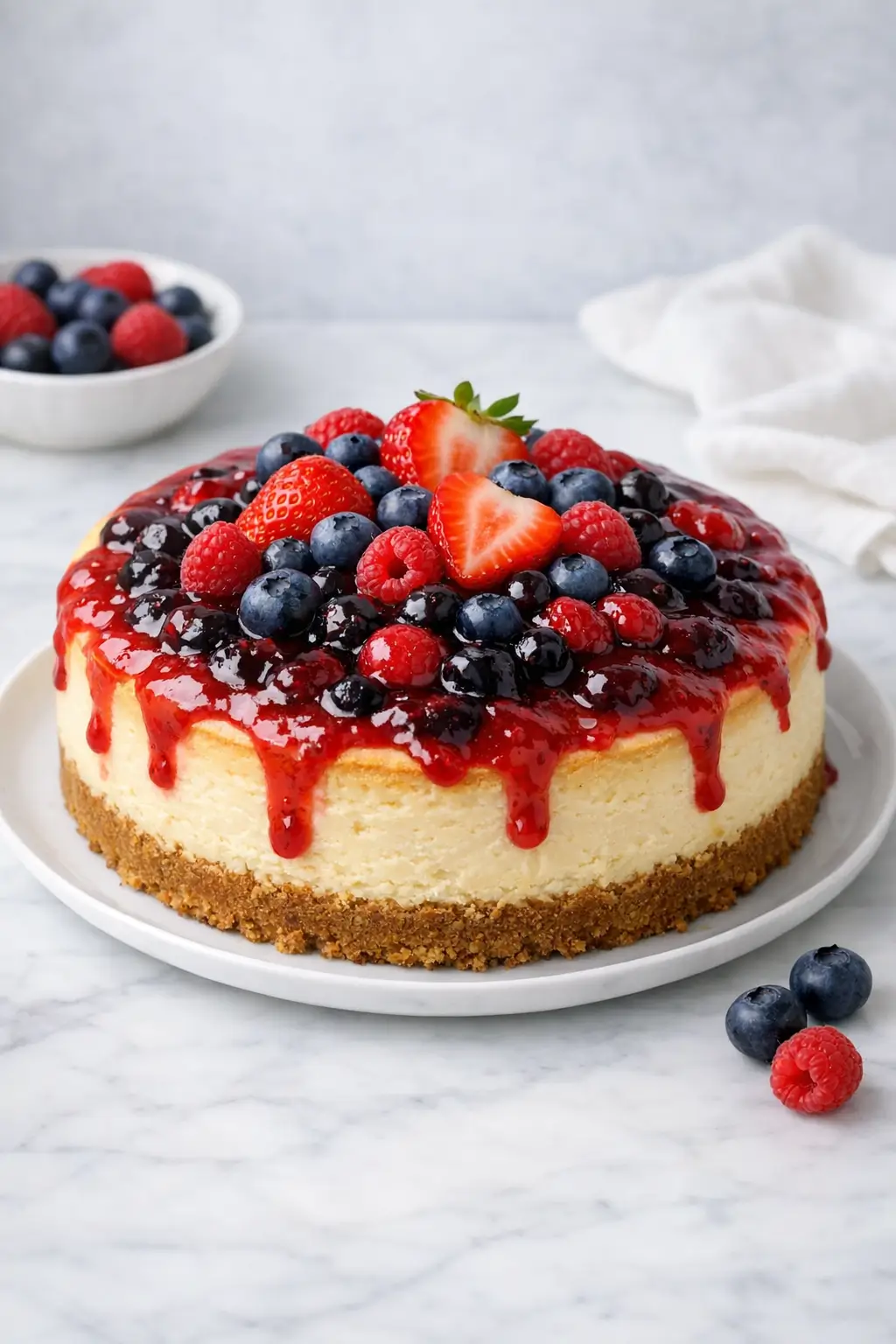
- Just before serving, spoon the chilled berry sauce over the top, letting some drip down the sides.
- Scatter fresh strawberries and blueberries over the sauce for a July Fourth red‑and‑blue effect.
- Slice with a sharp, thin knife, wiping the blade clean between cuts for neat slices.
What to Expect
This cheesecake bakes up dense enough to slice cleanly but still feels creamy and smooth on the tongue, not rubbery or dry. The filling leans lightly tangy from sour cream, with a gentle lemon note and a straightforward vanilla aroma.
The graham cracker crust has a familiar, slightly sweet crunch that softens just enough where it meets the filling. The berry sauce brings bright, jammy fruit—balanced between sweet and tart—that cuts through the richness.
Different ovens run hot or cool, so your baking time may land at the shorter or longer end of the range. Cream cheese brands vary, too; some contain slightly more moisture, which can make the filling a bit softer but still sliceable once thoroughly chilled.
Kitchen note: If your cheesecake develops a small crack, don’t panic. The berry sauce and fresh berries cover imperfections, and the flavor remains exactly the same.
Ways to Change It Up
Fourth-of-July swirl effect: Instead of spooning the berry sauce on top, reserve 1/2 cup of the cooled sauce. Dollop it over the unbaked filling and use a thin knife or skewer to gently swirl it in a loose pattern before baking. The trade-off is that the swirl can slightly soften the top texture, and the color will be more marbled than boldly red and blue.
Simplified no-water-bath version: If you’d rather skip the water bath, bake the cheesecake at 325°F / 165°C on a middle rack with a pan of hot water on the rack below. This gentler steam still helps, but the top is more prone to light cracking and may brown a touch more.
Vegan-inspired alternative: For a dairy-free crowd, you can use a ready-made vegan cream cheese and dairy-free sour cream substitute, following the same method. Expect a slightly different tang and a somewhat looser texture; these fillings can also brown faster at the edges, so start checking earlier.
Spicier, more complex berry sauce: Add a pinch of ground cinnamon or a scrape of fresh ginger to the berry sauce as it simmers. The spices give a warmer flavor that pairs nicely with grilled meats on the same plate, but they move the sauce away from a purely bright, summery profile.
Smaller batch for a tiny gathering: Halve all ingredients and bake the cheesecake in a 6‑inch springform pan. Baking time will shorten to roughly 45–60 minutes, so keep an eye on the wobble test instead of the clock.
Serving and Storage
A classic cheesecake with berry sauce is easiest to serve well-chilled. For a July Fourth cookout, keep the whole cheesecake in the refrigerator until 20–30 minutes before dessert, then add the berry sauce and fresh berries right before you bring it out.
It pairs naturally with grilled foods—think burgers, hot dogs, or grilled chicken—because the cold, creamy texture is a good contrast to smoky, salty mains. Offer lightly sweetened whipped cream on the side for guests who like extra richness, and keep a bowl of plain berries nearby for anyone who prefers a lighter dessert.
Leftover cheesecake keeps well, covered, in the refrigerator for 4–5 days. Store slices in a single layer in an airtight container, or return the springform ring around the cake and cover the top loosely.
The berry sauce will hold in the refrigerator for about 5 days in a covered container. You can also freeze undecorated cheesecake (without sauce) for up to 1 month: wrap it tightly in plastic and then in foil. Thaw overnight in the fridge before adding fresh sauce and berries.
Kitchen note: Avoid leaving cheesecake out at room temperature for more than 2 hours, especially in July heat. The rich dairy filling warms quickly and can soften to the point where slices slump when cut.
Cultural Context
Baked cream cheese cheesecakes with graham cracker crust are closely associated with 20th‑century American baking, particularly styles that developed in New York City. The use of graham crackers as a crumb crust became common as the crackers themselves rose in popularity; you can read more about their use in pies and cheesecakes in this overview of the graham cracker crust.
Fruit sauces made from berries and sugar—sometimes called coulis or compote—are widely used across cuisines to finish rich dairy desserts. In the United States, strawberry and blueberry sauces are especially common pairings with cheesecake and ice cream; both are described in entries such as this one on strawberry sauce.
Common Questions and Troubleshooting
My cheesecake cracked badly across the top. What happened?
Cracks usually come from sudden temperature changes, overbaking, or too much air in the batter. Next time, mix on low speed and stop as soon as the eggs are incorporated, use the water bath, and let the cheesecake cool gradually in the oven with the door cracked. For now, cover the crack with berry sauce and berries; it will still taste excellent.
The center looks underbaked even after chilling. Can I fix it?
If the center emerges very loose and still liquid, it likely needed more oven time. Once fully cooled and chilled, a slightly soft center is safe to eat but won’t slice as cleanly. You can serve the looser slices in small bowls with extra berry sauce on top. For your next attempt, bake longer and rely on the wobble test rather than only time.
Can I use low-fat cream cheese or Greek yogurt instead of full-fat cream cheese?
Low‑fat cream cheese will produce a noticeably softer and sometimes rubbery texture, and the filling may not set as well. Greek yogurt can replace some or all of the sour cream for a tangier flavor, but it should not replace the cream cheese entirely. If you do substitute, expect a lighter, slightly less silky result.
Can I make the cheesecake fully ahead for July Fourth?
Yes. The cheesecake benefits from an overnight rest and can be baked 1–2 days ahead. Keep it covered in the fridge and add berry sauce and fresh berries on the day you plan to serve. The sauce can also be made a day or two in advance and refrigerated.
How do I get really clean slices for guests?
Use a long, thin-bladed knife. Dip it in hot water, wipe it dry, make a cut, then wipe and repeat. Cleaning the knife between slices is the main factor in getting sharp edges, especially when you have a berry topping.
Can I skip the water bath if I’m short on time or equipment?
You can, but be prepared for more risk of cracking and slightly drier edges. If you don’t have a large roasting pan, at least place a pan of hot water on the lower rack and keep your oven temperature accurate. An inexpensive oven thermometer is worth having if you bake cheesecakes more than once.
Conclusion
Classic cheesecake with berry sauce fits neatly into a July Fourth menu because it can be finished well before guests arrive, then brought out looking fresh and festive with minimal effort. Once you’ve made it once or twice, the steps become routine: mix the crust, blend the filling gently, bake in a water bath, chill, and finish with a quick berry sauce.
If you try this version, leave a comment and a rating so others can see how it worked in a real home kitchen. I’d also be interested to hear which berry combinations you use and how you adjust the sweetness to suit your crowd.
Classic Cheesecake with Berry Sauce for July 4th

Equipment
- 9-inch (23 cm) springform pan
- Heavy-duty aluminum foil
- Large roasting pan or deep baking dish (for water bath)
- Mixing bowls
- Stand mixer with paddle attachment or hand mixer
- Rubber spatula
- Measuring cup (for pressing crust)
- Offset spatula
- Kettle or large pot (to boil water)
- Wire rack
- Small saucepan
- Whisk
- Thin knife (to loosen edges)
Ingredients
For the graham cracker crust
- 200 g graham cracker crumbs finely crushed (about 2 cups; about 14 full crackers)
- 75 g unsalted butter melted (about 6 Tbsp)
- 50 g granulated sugar (about 1/4 cup)
- 1/4 tsp fine sea salt omit if using salted butter
For the cheesecake filling
- 910 g full-fat cream cheese at room temperature (2 lb; four 8-oz blocks)
- 200 g granulated sugar (about 1 cup)
- 20 g all-purpose flour (about 2 Tbsp)
- 1/4 tsp fine sea salt
- 240 g full-fat sour cream at room temperature (about 1 cup)
- 5 large eggs at room temperature
- 10 ml pure vanilla extract (about 2 tsp)
- 5 ml fresh lemon juice (about 1 tsp) or use 1/2 tsp lemon zest
For the mixed berry sauce
- 300 g mixed berries fresh or frozen (about 2 cups; e.g., strawberries, blueberries, raspberries, and/or blackberries)
- 100 g granulated sugar (about 1/2 cup), adjust to taste
- 120 ml water (about 1/2 cup)
- 10 ml fresh lemon juice (about 2 tsp)
- 8 g cornstarch (about 1 Tbsp)
- 15 ml cold water for slurry (about 1 Tbsp)
- 1 pinch fine sea salt
To finish and serve
- extra fresh berries for topping (strawberries and blueberries especially fitting)
- lightly sweetened whipped cream optional
Instructions
- Place a rack in the lower-middle of the oven and preheat to 325°F / 165°C. Wrap the outside of a 9-inch (23 cm) springform pan tightly with two layers of heavy-duty foil (bottom and up the sides), lightly grease the inside, and set a large roasting pan or deep baking dish on the oven rack for the water bath.
- Make and bake the crust: In a bowl, mix graham cracker crumbs, sugar, and salt. Stir in melted butter until it resembles damp sand. Press firmly into the pan bottom and about 1 inch (2.5 cm) up the sides (a measuring cup helps). Bake 10 minutes, then cool slightly.
- Make the filling: Reduce oven to 300°F / 150°C. Beat cream cheese on medium-low 2–3 minutes until completely smooth, scraping the bowl. Add sugar, flour, and salt; mix just until smooth. Mix in sour cream. Lightly beat eggs in a small bowl, then add to the batter on low in 2–3 additions, mixing only until blended. Mix in vanilla and lemon juice briefly, then tap the bowl to release large air bubbles.
- Fill pan and set up the water bath: Pour filling over crust and smooth the top. Bring water to a boil. Place the foil-wrapped springform pan into the roasting pan and carefully pour hot water into the roasting pan until it reaches about halfway up the sides of the springform.
- Bake at 300°F / 150°C for 65–80 minutes (start checking at 65). It’s done when the outer 2–3 inches (5–7 cm) are set and the center still has a slight wobble. If browning too much, tent loosely with foil for the last 15–20 minutes.
- Cool gradually: Turn off oven, crack the door, and let cheesecake sit in the water bath 45–60 minutes. Remove roasting pan from oven, lift out springform, and cool on a wire rack. Remove foil and run a thin knife around the inside edge. Cool uncovered at room temperature about 2 hours, then cover loosely and refrigerate at least 4 hours (preferably overnight).
- Make the berry sauce: In a small saucepan, combine berries, sugar, water, lemon juice, and a pinch of salt. Simmer over medium, stirring, 3–5 minutes until berries release juice. Whisk cornstarch with cold water to make a slurry, then slowly stir it into the berries. Cook 2–4 minutes more until thick, glossy, and syrupy. Cool to room temperature, then chill (loosen with a little water if it becomes too thick).
- Unmold and serve: Release the springform latch and remove the ring. (Optional) Slide a thin wide spatula under the crust to transfer to a serving plate. Spoon chilled berry sauce over the top, add fresh berries, and slice with a sharp thin knife, wiping between cuts. Serve with whipped cream if desired.



Leave a Reply