
Maple glazed salmon with roasted veggies is one of those sheet pan dinners that looks impressive but quietly fits into a packed week. You get crisp-edged vegetables, tender salmon, and a glossy maple Dijon glaze in about 35 minutes, with just one pan to wash.
If you’re racing the clock on a weeknight, start by getting the oven heating and the sweet potatoes cut, since they need the longest time. Cooking in a tiny kitchen? Toss the veggies right on the lined sheet pan so you only dirty one bowl.
This style of meal is common anywhere quick oven-roasted dinners are popular, especially in North American home kitchens where salmon and maple syrup are easy to find. It works well for newer cooks who like clear timing, and for more experienced cooks who want a flexible template. Expect a balance of mild sweetness, savory soy and garlic notes, and roasted edges rather than restaurant-style perfect cubes.
Ingredients
Serves 3–4
For the roasted veggies
- 400 g / 14 oz sweet potato, peeled and cut into 1.5 cm / 1⁄2-inch cubes (roasts soft and sweet)
- 250 g / 9 oz broccoli florets (about 1 small head), cut into bite-size pieces
- 150 g / 5 oz carrots, peeled and sliced into 1 cm / 3⁄8-inch coins
- 1 small red onion (about 80 g / 3 oz), cut into wedges
- 2 tbsp (30 ml) olive oil
- 1⁄2 tsp fine sea salt, plus more to taste
- 1⁄4 tsp freshly ground black pepper
For the maple glaze and salmon
- 4 skin-on salmon fillets, 120–150 g / 4–5 oz each, pin bones removed
- 1⁄4 cup (60 ml) pure maple syrup (not pancake syrup)
- 1 tbsp (15 ml) low-sodium soy sauce or tamari for gluten-free
- 1 tbsp (15 g) Dijon mustard
- 1 tbsp (15 ml) olive oil
- 1 tbsp (15 ml) lemon juice or cider vinegar
- 1 small garlic clove, finely minced (about 1 tsp / 3 g)
- 1 tsp freshly grated ginger or 1⁄2 tsp ground ginger
- 1⁄4 tsp red pepper flakes or a pinch of cayenne, optional for heat
- 1⁄2 tsp fine sea salt, plus more to season salmon
- Freshly ground black pepper, to taste
To finish (optional but nice)
- Lemon wedges, for serving
- 2 tbsp chopped fresh parsley or dill or chives
- 1 tsp toasted sesame seeds, for a little crunch
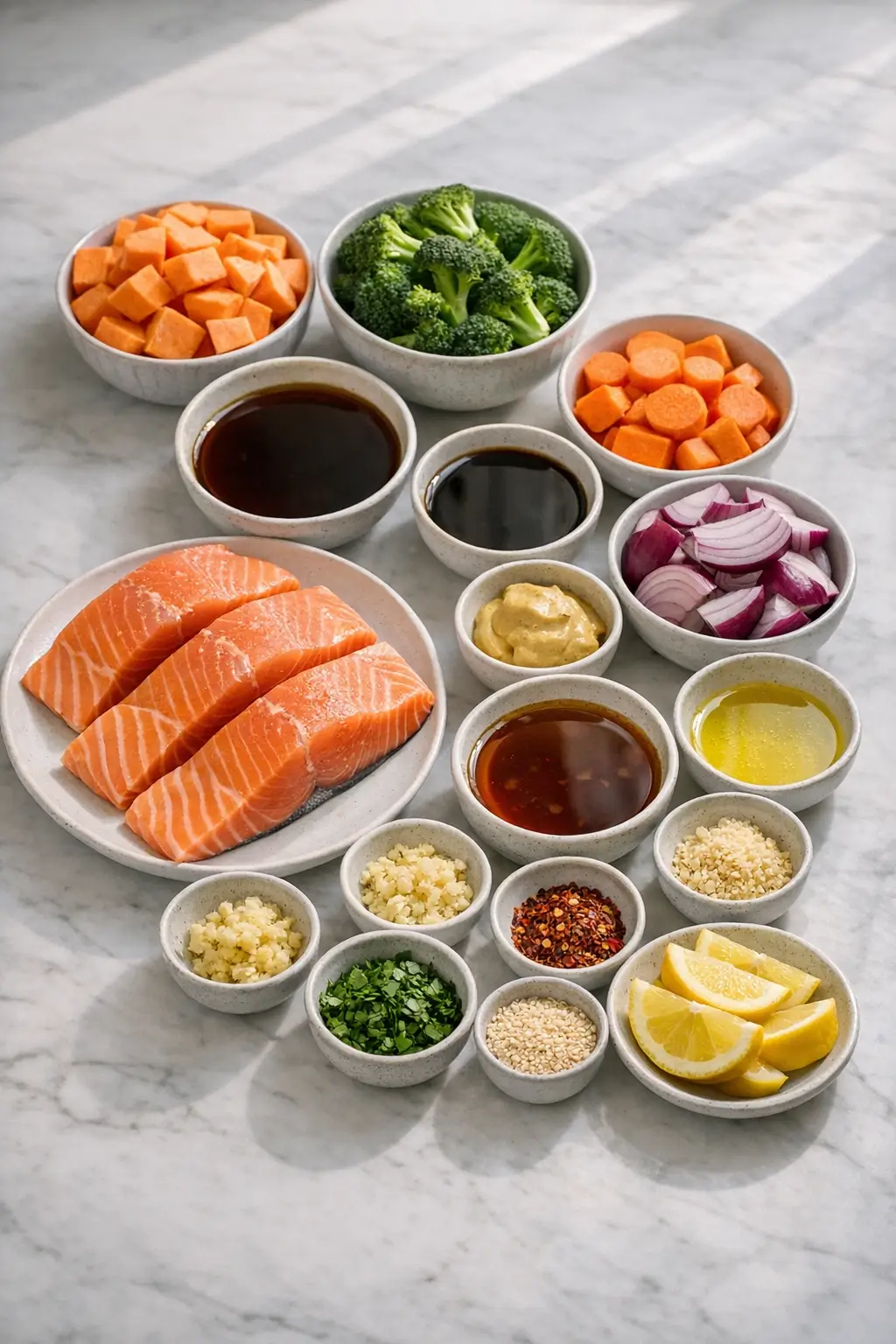
Kitchen note: Aim for similar-size vegetable pieces so the sweet potato, carrots, and broccoli roast in the same window. Too many tiny bits burn before the salmon is done.
Step-by-Step Instructions for Maple Glazed Salmon with Roasted Veggies
-
Preheat the oven and prepare the pan.
Heat the oven to 425°F / 220°C. Line a large rimmed sheet pan (about 18×13 inches / 46×33 cm) with parchment paper or foil for easier cleanup. -
Toss the vegetables.
On the pan or in a large bowl, combine the sweet potato cubes, broccoli florets, carrot slices, and red onion wedges. Drizzle with 2 tbsp olive oil, then sprinkle with 1⁄2 tsp salt and 1⁄4 tsp pepper. Toss until every piece looks lightly coated; spread into an even layer, leaving a rough empty strip down the center for the salmon later. -
Start roasting the veggies.
Place the tray on the middle rack and roast for 12–15 minutes, until the sweet potatoes are just starting to soften and the broccoli edges look a little browned. This head start keeps you from overcooking the fish while you wait on firm vegetables. -
Mix the maple glaze.
While the vegetables roast, whisk together the maple syrup, soy sauce, Dijon mustard, 1 tbsp olive oil, lemon juice, minced garlic, grated ginger, red pepper flakes (if using), 1⁄2 tsp salt, and a few grinds of black pepper in a small bowl. The mixture should be thick enough to cling to a spoon but still pourable. -
Pat the salmon dry and season.
Use paper towels to pat each salmon fillet dry on both sides; this helps the glaze stick and encourages light browning. Lightly season the flesh side with a small pinch of salt and pepper. You will add plenty of flavor with the glaze, so don’t oversalt here. -
Add the salmon to the pan.
When the vegetables have had their head start, pull the sheet pan from the oven and reduce heat slightly to 400°F / 200°C if your oven runs hot. Use a spatula to push the vegetables out toward the edges and corners, creating four spaces in the center. Place the salmon fillets skin-side down in those spaces, leaving a little room between pieces. -
Brush on most of the glaze.
Spoon or brush about two-thirds of the maple glaze over the top and sides of the salmon, coating evenly. Drizzle a tablespoon or two of the remaining glaze over the vegetables and toss them gently right on the pan.
Kitchen note: Keep the glaze mostly on the fish and veggies, not pooling on the bare pan. Excess sugar on exposed metal tends to burn and smoke before the salmon is cooked.
-
Roast until the salmon is just cooked.
Return the pan to the oven and roast for 10–12 minutes, depending on fillet thickness. The salmon is done when it looks opaque on the sides, flakes easily with a fork, and registers about 125–130°F / 52–54°C in the thickest part for medium. If you prefer fully cooked fish, go up to 135°F / 57°C, but avoid much higher to keep it moist. -
Optional quick broil for color.
For more caramelized glaze, switch the oven to broil on high and move the pan to the upper third of the oven for 1–2 minutes. Watch closely; the maple sugars can go from browned to bitter quickly. -
Finish with the remaining glaze and garnishes.
Remove the pan from the oven. Spoon the last third of the maple glaze over the salmon while it’s still hot. Scatter chopped parsley and sesame seeds over the vegetables and fish, and serve right from the pan with lemon wedges on the side.
Kitchen note: If some vegetable pieces still feel too firm when the salmon is done, lift the fish onto a plate and tent it loosely with foil. Return just the veggies to the oven for an extra 5–8 minutes, then serve everything together.
What to Expect
The finished salmon should be moist and flaky, not dry, with a lightly sticky surface from the maple glaze. You’re aiming for tender flesh that separates in large flakes when nudged with a fork.
Vegetables come out with browned, crisp edges and soft centers. Sweet potatoes turn creamy and slightly caramelized, while broccoli and carrots keep a bit of bite unless roasted much longer.
Flavor-wise, the glaze leans slightly sweet, balanced by Dijon mustard’s tang, soy sauce’s saltiness, and a small hit of garlic and ginger. If you use the red pepper flakes, you’ll get a gentle warmth, not a spicy dish.
Different ovens brown at different rates. A very hot-running oven may give deeper char on the broccoli before the sweet potatoes fully soften, which is why the initial roast is important. Thicker salmon fillets (closer to 5 oz / 150 g) will stay juicier and need the full time; very thin tail pieces may be done in 8–9 minutes.
Kitchen note: If your salmon develops white protein (albumin) on the surface, it’s usually a sign of slightly higher heat or longer cooking. It’s harmless but you can scrape it off gently with a knife before serving if you prefer.
Ways to Change It Up
-
Vegetarian or vegan sheet pan variation.
Skip the salmon and roast 400 g / 14 oz extra-firm tofu, pressed and cut into thick slabs or cubes, alongside the vegetables. Toss the tofu with a tablespoon of oil and a spoonful of cornstarch before glazing so it crisps at the edges. The maple glaze is already vegan if you use tamari, so you can apply it exactly the same way, adding a couple of minutes to the roasting time as needed. -
Milder version for kids or spice-sensitive eaters.
Leave out the red pepper flakes and go a touch heavier on the lemon juice when serving. You can also reduce the soy sauce slightly and add a pinch more salt to the vegetables instead, which softens the savory edge of the glaze. -
Spicier maple glazed salmon.
Double the red pepper flakes or stir in 1–2 tsp of your favorite chili-garlic sauce to the glaze. Another option is to sprinkle a little smoked paprika or ground chipotle on the salmon before brushing it with the maple mixture for a smoky, spicy finish. -
Faster, more streamlined version.
Use only two vegetables—say, sweet potato and broccoli—at roughly 500 g / 1.1 lb total, cut them small, and roast at 425°F / 220°C without lowering the heat. This trims both prep and cook time and keeps the whole meal closer to 25–30 minutes. -
Different vegetable combinations.
Swap some or all of the veggies for Brussels sprouts, parsnips, butternut squash, or green beans. Firm, dense vegetables like squash and parsnips should be cut smaller so they soften in time. Very quick-cooking choices like asparagus can be added only for the last 8–10 minutes.
Kitchen note: When mixing and matching vegetables, think about their density. Hard, starchy vegetables need the longest time; delicate greens and asparagus should go in last so they don’t shrivel.
Serving and Storage
Maple glazed salmon with roasted veggies is designed to be served straight from the sheet pan. Use a wide spatula to lift a fillet with a scoop of vegetables and slide it onto warmed plates.
For a more filling meal, pair it with cooked brown rice, quinoa, couscous, or crusty bread to catch any extra glaze and juices. A simple green salad with a bright vinaigrette or a tangy slaw balances the sweetness of the maple.
Leftovers keep surprisingly well. Cool completely, then store salmon and vegetables together or separately in airtight containers in the refrigerator for up to 3 days. For best texture, avoid freezing; cooked salmon tends to flake apart and dry out when thawed.
To reheat, place portions on a small baking tray, cover loosely with foil, and warm in a 300°F / 150°C oven for 10–12 minutes, just until heated through. The goal is to gently reheat without cooking the salmon further.
A quicker option is the microwave: reheat on medium power in 30-second bursts, checking often. Expect the glaze to be a bit less glossy and the fish slightly firmer than when freshly cooked.
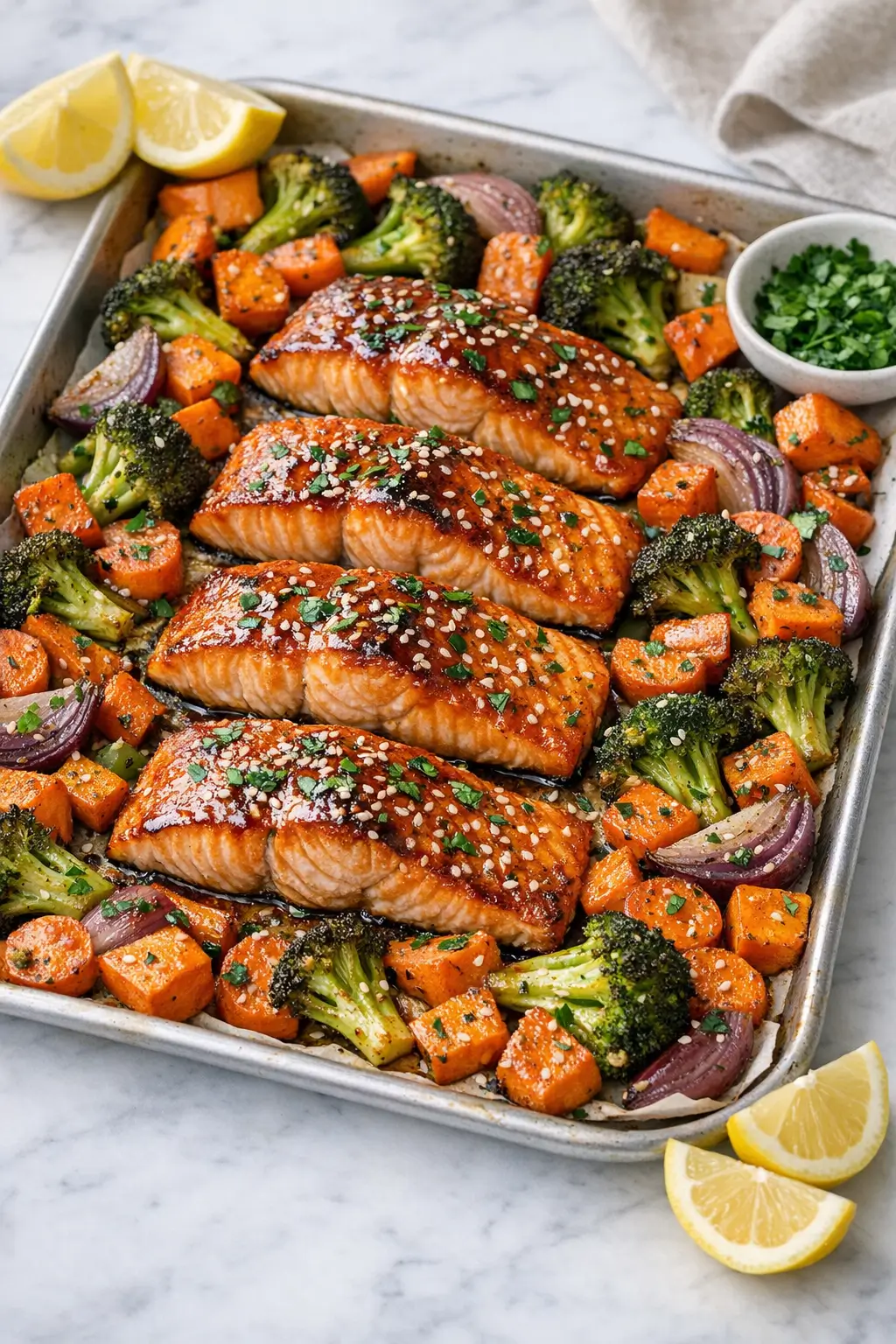
Kitchen note: If you know you’ll be reheating, pull the salmon from the oven when it’s closer to 120–122°F / 49–50°C in the center. That way, a brief reheat won’t push it past well done.
Cultural Context
Baking salmon with vegetables on a single pan is a modern home-kitchen approach, but both salmon and maple syrup have long histories in North America. Salmon has been a central food, economic resource, and cultural touchstone for many Indigenous communities along the Pacific coast, sometimes described collectively as “Salmon People” because of this deep connection. Resources from institutions like the Smithsonian’s National Museum of the American Indian describe how salmon is intertwined with identity, ceremony, and treaty rights in the Pacific Northwest.
For more background, see this overview on salmon and Native communities from the Smithsonian: Food and culture of Pacific Northwest Native Nations, and NOAA’s explanation of the ecological roles and cultural importance of Pacific salmon: Saving Pacific Salmon and Steelhead.
Common Questions and Troubleshooting
Why are my vegetables still hard when the salmon is cooked?
This usually means the vegetable pieces were too large or the oven temperature is running low. Next time, cut dense vegetables like sweet potatoes and carrots smaller and give them a slightly longer head start (15–18 minutes) before adding the salmon. In the moment, lift the salmon off the pan, tent it with foil, and return just the vegetables to the oven until tender.
My salmon came out dry. What happened?
Overcooking is the most common cause. Thin fillets cook much faster than thick ones, so start checking at 8–9 minutes, especially near the tail end. An instant-read thermometer is helpful here—aim for 125–130°F / 52–54°C and remember that the internal temperature rises a little as it rests.
Can I use frozen salmon fillets?
Yes, but thaw them completely in the refrigerator first, then pat very dry so the glaze adheres. Frozen fillets are sometimes thinner than fresh ones, so check for doneness early. If you must bake from frozen, give the vegetables a bit more time, then add the salmon and expect a slightly longer overall cook.
What can I substitute for maple syrup?
Pure maple syrup is key to the flavor profile here, but in a pinch you can use liquid honey. The glaze will be slightly thicker and a bit less complex, so you may want to add an extra squeeze of lemon juice to brighten it.
Is there a way to reduce the sodium without losing flavor?
Use low-sodium soy sauce or tamari, and be modest with the added salt on both salmon and vegetables. Extra lemon juice, more fresh herbs, and a pinch of red pepper flakes can boost flavor without more salt.
Can I double the recipe?
You can, but you’ll need two sheet pans so the vegetables and salmon have room. Roast the veggies on the upper and lower racks, swapping positions halfway through. When it’s time to add the salmon, put the fish on the more central pan so you can monitor doneness easily.
Kitchen note: If you crowd everything onto one pan when doubling, the vegetables will steam instead of roast, and you’ll miss out on that caramelized flavor.
Conclusion
Maple glazed salmon with roasted veggies is a practical way to put a balanced meal on the table with limited prep and dishes. Once you’ve made it once or twice, you can adjust the vegetables, tweak the sweetness or heat of the glaze, and scale it up or down based on who is eating.
If you try this version, I’d value your feedback—leave a comment and a rating so other home cooks can see how it went for you. Share any vegetable combinations or timing tweaks that worked in your oven; those small real-world adjustments are what make this kind of recipe reliably useful in everyday kitchens.
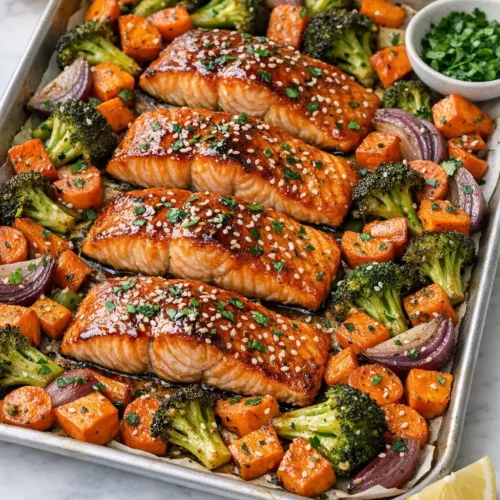
Maple Glazed Salmon with Roasted Veggies

Equipment
- Large rimmed sheet pan (about 18×13 inches / 46×33 cm)
- Parchment paper or foil
- Large bowl (optional, for tossing vegetables)
- Small bowl
- Whisk
- Spatula
- Paper towels
- Instant-read thermometer (optional)
Ingredients
For the roasted veggies
- 400 g sweet potato peeled and cut into 1.5 cm / 1/2-inch cubes
- 250 g broccoli florets cut into bite-size pieces (about 1 small head)
- 150 g carrots peeled and sliced into 1 cm / 3/8-inch coins
- 1 small red onion cut into wedges (about 80 g / 3 oz)
- 2 tbsp olive oil
- 1/2 tsp fine sea salt plus more to taste
- 1/4 tsp freshly ground black pepper
For the maple glaze and salmon
- 4 skin-on salmon fillets 120–150 g / 4–5 oz each; pin bones removed
- 1/4 cup pure maple syrup not pancake syrup
- 1 tbsp low-sodium soy sauce or tamari for gluten-free
- 1 tbsp Dijon mustard
- 1 tbsp olive oil
- 1 tbsp lemon juice or cider vinegar
- 1 small clove garlic finely minced (about 1 tsp / 3 g)
- 1 tsp freshly grated ginger or 1/2 tsp ground ginger
- 1/4 tsp red pepper flakes optional; or a pinch of cayenne
- 1/2 tsp fine sea salt plus more to season salmon
- freshly ground black pepper to taste
To finish (optional but nice)
- lemon wedges for serving
- 2 tbsp chopped fresh parsley or dill or chives
- 1 tsp toasted sesame seeds
Instructions
- Preheat the oven and prepare the pan. Heat the oven to 425°F / 220°C. Line a large rimmed sheet pan (about 18×13 inches / 46×33 cm) with parchment paper or foil for easier cleanup.
- Toss the vegetables. On the pan or in a large bowl, combine the sweet potato cubes, broccoli florets, carrot slices, and red onion wedges. Drizzle with 2 tbsp olive oil, then sprinkle with 1/2 tsp salt and 1/4 tsp pepper. Toss until lightly coated; spread into an even layer, leaving a rough empty strip down the center for the salmon later.
- Start roasting the veggies. Roast for 12–15 minutes, until the sweet potatoes are just starting to soften and the broccoli edges look a little browned.
- Mix the maple glaze. Whisk together the maple syrup, soy sauce, Dijon mustard, 1 tbsp olive oil, lemon juice, minced garlic, grated ginger, red pepper flakes (if using), 1/2 tsp salt, and a few grinds of black pepper in a small bowl.
- Pat the salmon dry and season. Pat each salmon fillet dry. Lightly season the flesh side with a small pinch of salt and pepper.
- Add the salmon to the pan. Pull the sheet pan from the oven and reduce heat slightly to 400°F / 200°C if your oven runs hot. Push the vegetables toward the edges and corners, creating four spaces. Place salmon fillets skin-side down in those spaces.
- Brush on most of the glaze. Spoon or brush about two-thirds of the maple glaze over the salmon. Drizzle 1–2 tablespoons of the remaining glaze over the vegetables and toss gently on the pan.
- Roast until the salmon is just cooked. Roast 10–12 minutes, depending on thickness, until salmon is opaque on the sides and flakes easily (about 125–130°F / 52–54°C for medium; up to 135°F / 57°C for fully cooked).
- Optional quick broil for color. Broil on high with the pan in the upper third of the oven for 1–2 minutes, watching closely so the glaze doesn’t burn.
- Finish with the remaining glaze and garnishes. Spoon the last third of the glaze over the hot salmon. Scatter chopped parsley and sesame seeds over the vegetables and fish and serve with lemon wedges.



Leave a Reply