
On hot evenings when the stove already feels like too much, peach cobbler in a skillet delivers all the payoff of a classic summer dessert with almost no fuss. This version uses a cast-iron (or any oven-safe) skillet, fresh or frozen peaches, and a simple stir-together batter that bakes up into a soft, cake-like topping. You get juicy fruit, crisp-edged crust, and the kind of aroma that makes people wander into the kitchen.
If it’s a busy weeknight, start by getting the oven heating and slice the peaches first; that buys you time to mix the batter while the fruit softens. Cooking in a small kitchen? Keep this truly one-pan by melting the butter and building everything right in the skillet, so you only wash a bowl and a spoon.
Ingredients
Serves 4
For the peach layer
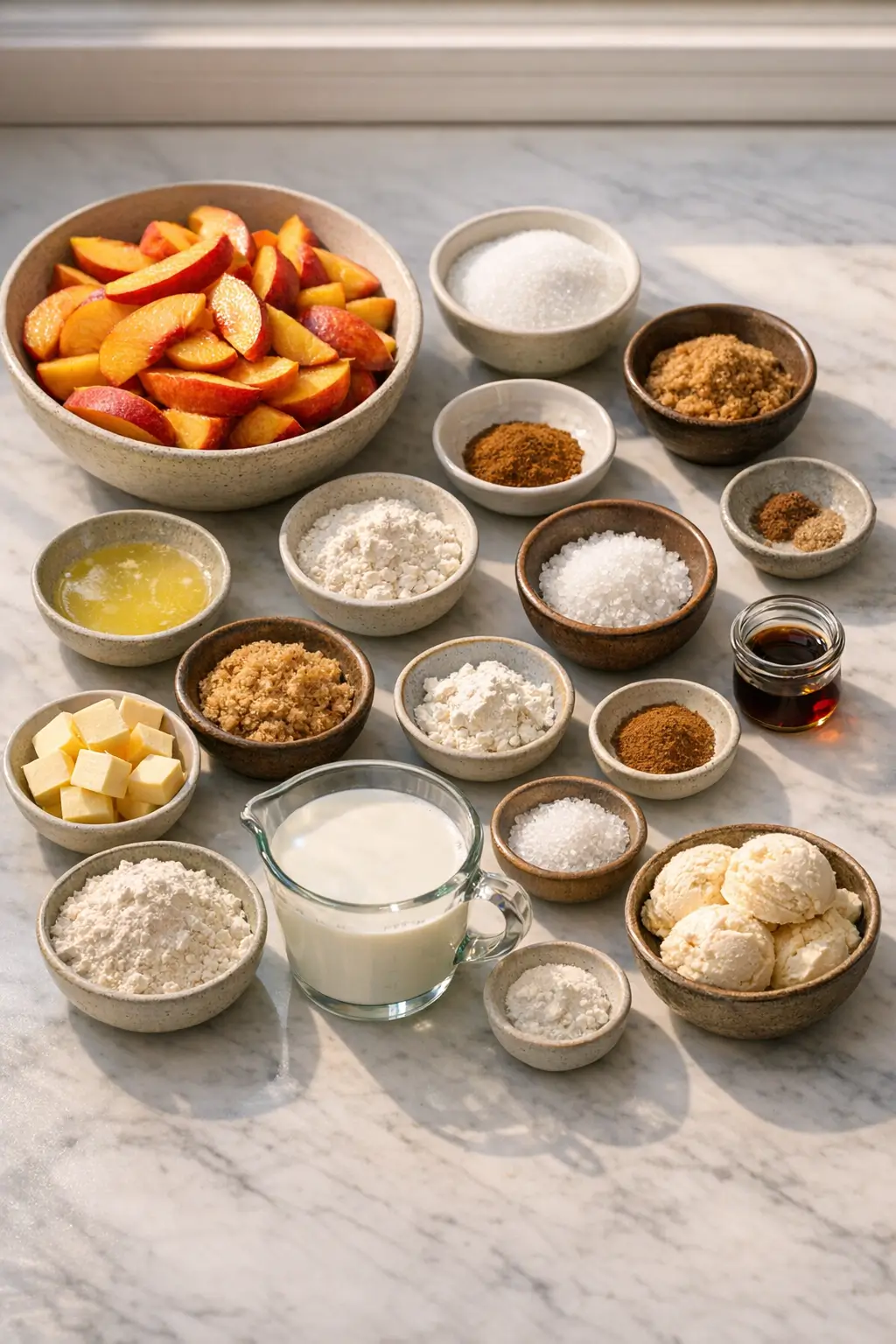
- 700 g / 1½ lb ripe peaches (about 4–5 medium), pitted and sliced into 1–1.5 cm / ½-inch wedges; peeling optional
- 60 g / ¼ cup granulated sugar
- 30 g / 2 tbsp light brown sugar, packed
- 1 tbsp fresh lemon juice
- ½ tsp ground cinnamon
- ⅛ tsp ground nutmeg (optional, but deepens the flavor)
- ¼ tsp fine sea salt or table salt
- 10 g / 1 tbsp cornstarch
For the skillet and batter
- 85 g / 6 tbsp unsalted butter, cut into pieces
- 125 g / 1 cup all-purpose flour
- 8 g / 2 tsp baking powder
- ¼ tsp fine sea salt or table salt
- 150 g / ¾ cup granulated sugar
- 240 ml / 1 cup whole milk (or 2% milk)
- 1 tsp vanilla extract
To finish (optional but recommended)
- 1–2 tbsp coarse or granulated sugar, for sprinkling
- ¼ tsp ground cinnamon, for sprinkling
- Vanilla ice cream or lightly sweetened whipped cream, for serving
Substitution notes:
- You can use 700 g / 1½ lb frozen peach slices (no need to thaw; add 1 extra teaspoon cornstarch to absorb more juice).
- Replace part of the peaches with berries (up to ⅓ of the fruit) for a mixed-fruit cobbler.
- For dairy-free, use a neutral oil or vegan butter for the pan and a rich plant milk (like oat or soy) in the batter; texture will be slightly less rich but still soft and spoonable.
Step-by-Step Instructions for peach cobbler in a skillet
- Preheat the oven and prepare the skillet.
- Set your oven to 190°C / 375°F with a rack in the middle.
- Place a 25 cm / 10-inch cast-iron or other oven-safe skillet in the oven with the 85 g / 6 tbsp butter in it so the butter melts as the oven heats, 5–8 minutes.
- Keep an eye on it; you want melted (and lightly nutty if it browns a bit), not burnt, butter.
- Mix the peaches.
- In a medium bowl, combine the sliced peaches, 60 g / ¼ cup sugar, 30 g / 2 tbsp brown sugar, 1 tbsp lemon juice, ½ tsp cinnamon, ⅛ tsp nutmeg, and ¼ tsp salt.
- Sprinkle 10 g / 1 tbsp cornstarch over the top and toss again until no dry pockets of starch remain.
- The fruit should look glossy and slightly syrupy after a minute of sitting.
Kitchen note: If your peaches are very firm and not very juicy, toss them and let them stand for 10 minutes so they release some liquid before baking. If they’re extremely juicy, you can add another teaspoon of cornstarch to avoid a watery cobbler.
- Whisk the batter.
- In a separate bowl, whisk together the 125 g / 1 cup flour, 8 g / 2 tsp baking powder, ¼ tsp salt, and 150 g / ¾ cup sugar.
- Add the 240 ml / 1 cup milk and 1 tsp vanilla.
- Whisk just until you have a smooth, pourable batter with no big lumps. It should be similar to pancake batter.
- Build the cobbler in the hot skillet.
- Carefully remove the hot skillet from the oven (the handle will be very hot) and swirl gently so the melted butter coats the bottom.
- Pour the batter evenly over the melted butter. Do not stir—the butter will float up the sides and help create crisp, golden edges.
- Spoon the peaches and all their juices evenly over the batter. Again, do not mix; the batter will rise up around the fruit as it bakes.
Kitchen note: It will look like too much liquid sitting on top of the batter. That’s correct. The oven heat thickens the juices and the batter puffs around the fruit as it cooks.
- Bake until puffed and golden.
- Return the skillet to the oven.
- Bake 30–40 minutes, until the cobbler is deeply golden, the edges are crisp, and the center looks set but still slightly soft.
- Rotate the skillet after 20 minutes if your oven has hot spots.
- Add a sugar crust (optional).
- For a lightly crackly top, quickly pull the skillet out at the 25-minute mark.
- Sprinkle with 1–2 tbsp sugar mixed with ¼ tsp cinnamon, then return it to finish baking.
- This mimics the crisp sugar “lid” some traditional cobbler recipes use.
- Check for doneness.
- The peach juices around the edges should be actively bubbling.
- Insert a knife or skewer into the batter portion near the center; it should come out without raw, wet batter (a bit of soft, moist crumb is fine).
- If the top is browning too fast but the center is still loose, tent loosely with foil and continue baking 5–10 more minutes.
Kitchen note: Metal skillets retain heat and keep cooking the cobbler after it leaves the oven. If you wait for the very center to look completely dry in the oven, it will overbake and turn dense as it cools.
- Cool briefly and serve.
- Let the cobbler rest 10–15 minutes so the juices thicken and the topping finishes setting.
- Serve warm, straight from the skillet, with scoops of vanilla ice cream or spoonfuls of softly whipped cream.
What to Expect
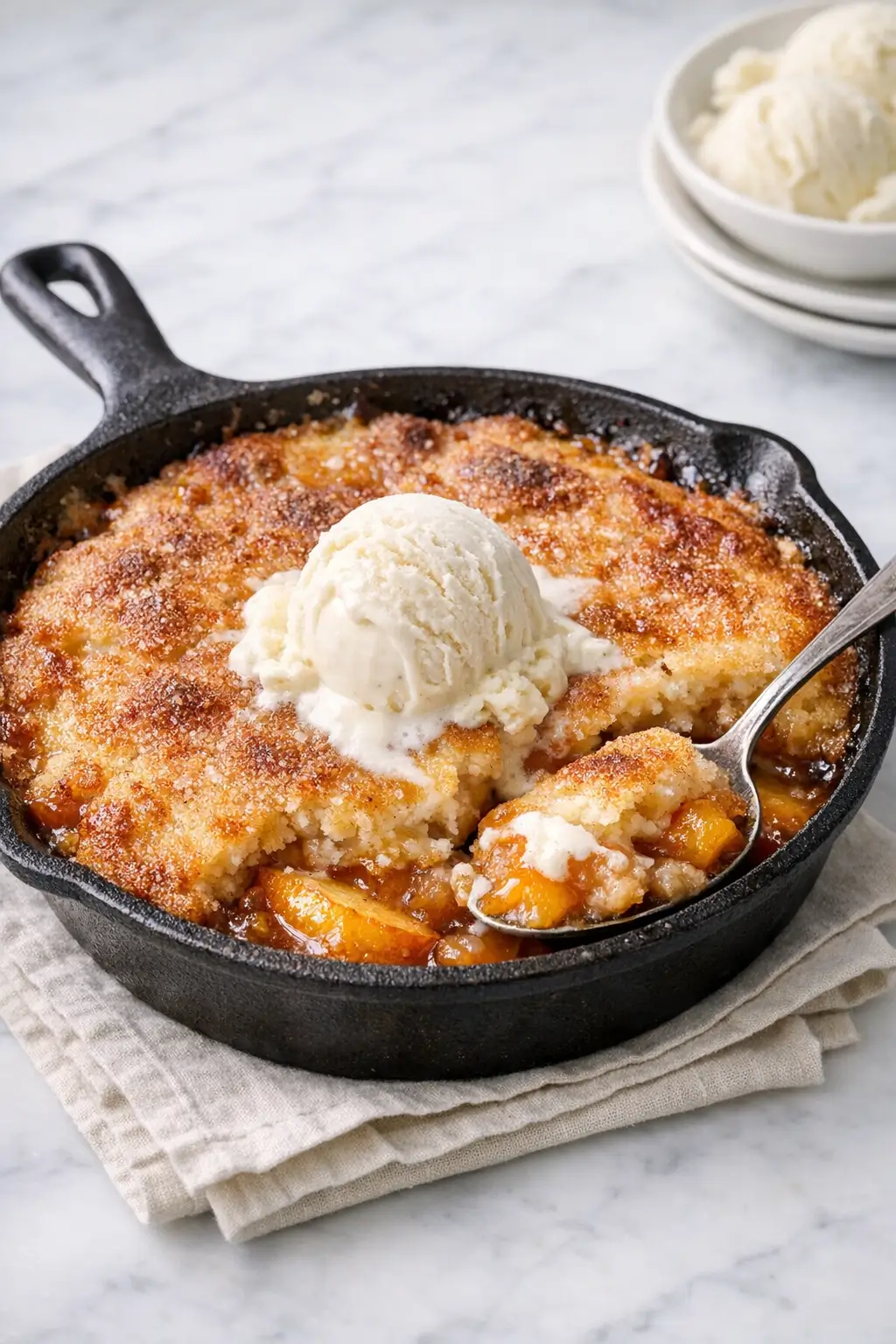
The finished cobbler has a soft, spoonable topping—more like a tender cake than a crisp biscuit—floating over sweet, jammy peaches.
Edges will be the most caramelized and chewy from contact with the hot skillet and butter, while the center stays softer and more custardy.
Flavor-wise, expect a clear peach flavor first, supported by gentle cinnamon and vanilla rather than heavy spice. Lemon juice keeps the sweetness from feeling flat. If you used very sweet, ripe peaches, the dessert will taste sweeter overall; with out-of-season or frozen fruit you may taste the tartness a bit more.
Pan material and size do matter. A darker cast-iron or black steel skillet will brown the edges faster than a pale enamel or stainless pan, and a slightly larger skillet will give you more crisp surface and a thinner layer of batter.
Kitchen note: If you prefer a firmer, more biscuit-like topping, you can bake a few minutes longer until the center is fully set and lightly springy to the touch, but don’t go much beyond that or the topping will dry out.
Ways to Change It Up
- Vegetarian and vegan versions.
- The base recipe is already vegetarian.
- For a vegan take, swap the butter for a vegan block-style margarine or coconut oil and use your favorite unsweetened plant milk in the batter.
- Coconut oil will add a light coconut flavor; a neutral vegetable oil keeps the taste closer to the original.
- Spicier or more aromatic.
- For more spice, increase cinnamon to 1 tsp and nutmeg to ¼ tsp, or add ¼ tsp ground ginger or cardamom to the peaches.
- You can also add a splash (1–2 tbsp) of bourbon or dark rum to the fruit mixture; most of the alcohol will cook off, leaving warmth and complexity.
- To go milder, simply omit nutmeg and use just ¼ tsp cinnamon so the peaches are even more forward.
- Faster weeknight version.
- Use canned peaches in juice, drained lightly (about 700 g / 24 oz drained weight), and skip the cornstarch since the juices are already somewhat thick.
- Reduce the sugar in the fruit layer by about a third if your canned peaches are very sweet.
- Because canned fruit is already soft, your bake time may be closer to 25–30 minutes.
- Crispier top variation.
- Replace 2–3 tablespoons of the flour in the batter with fine cornmeal for a slightly nubbly, crispier crust.
- A quick run under the broiler for 1–2 minutes at the end can also deepen browning—just watch closely to prevent burning.
Serving and Storage
Peach cobbler in a skillet is best within an hour of baking, while the top is still crisp at the edges and the fruit is warm and saucy.
Serve it directly from the skillet at the table (with a trivet under the pan), and let everyone scoop portions for themselves.
Classic pairings are vanilla ice cream, lightly sweetened whipped cream, or a pour of cold heavy cream over each serving. For a less sweet contrast, try plain Greek yogurt alongside. In summer, it fits naturally at cookouts, casual dinners, or as a simple dessert after grilled meats and salads.
Leftovers should be cooled to room temperature and then transferred to an airtight container; refrigerate up to 3 days.
To reheat, spoon individual portions into an oven-safe dish and warm at 160°C / 325°F for 10–15 minutes, or microwave in short bursts just until warmed through.
Kitchen note: Avoid storing the cobbler directly in a cast-iron skillet in the fridge for more than a few hours; the acidic fruit can strip the seasoning from the pan and pick up metallic flavors over time.
Cultural Context
Peach cobbler is widely associated with the American South, where peaches became an important crop in the 19th century and home cooks relied on fruit desserts that could be baked in simple pans or cast-iron over coals. Early cobblers were often made by placing fruit in deep pots and topping it with biscuit dough before cooking over a fire, a practical adaptation of British puddings and pies.
According to the Levine Museum of the New South, cobblers helped bridge European baking techniques with local ingredients and were easier to prepare than traditional pies in frontier conditions. Their peach cobbler feature notes how peaches were carried throughout the South and how cobblers evolved alongside canning and commercial peach production over time: this overview of peach cobbler history and Southern foodways offers a concise background.
More broadly, cobblers appear in food history discussions as part of Southern and African American home cooking traditions, with many family recipes passed through generations. For a wider look at how desserts like peach cobbler fit into Southern baking, see this piece on Southern baking and regional food culture.
Common Questions and Troubleshooting
My cobbler topping baked up dense instead of light. What happened?
This usually comes from overmixing the batter or baking too long. Next time, whisk just until the flour disappears; a few small lumps are fine. Also check your baking powder’s freshness—old leavening loses power—and aim to pull the cobbler when the center is just set, not dry.
The peach layer came out soupy. How can I fix that?
If your peaches are very ripe and juicy or were frozen, you may need a touch more cornstarch. You can also let the fruit sit with sugar for 10 minutes, then taste and add up to 1 more teaspoon of cornstarch before baking. Make sure you bake until the juices are actively bubbling; that’s when the starch fully thickens.
Can I use only canned peaches for this skillet cobbler?
Yes. Drain them well, taste the syrup to gauge sweetness, and reduce the sugar in the fruit mixture accordingly. Because canned peaches are already soft, shorten the bake time slightly and watch that the top doesn’t overbrown.
The edges browned before the center was done. How do I prevent this?
Move your oven rack down one position so the skillet sits a bit lower, and tent the edges loosely with foil once they reach a deep golden color. A slightly thicker skillet or a lighter-colored pan will also slow down edge browning.
Can I make this ahead for a summer gathering?
You can slice and sugar the peaches a few hours in advance and keep them refrigerated, and you can whisk the dry ingredients for the batter ahead of time. Assemble and bake just before serving so the topping stays crisp at the edges. Leftovers reheat reasonably well, but the best texture is always fresh from the oven.
Kitchen note: If you need more flexibility, underbake the cobbler by 5 minutes, cool, and refrigerate. Reheat in a 175°C / 350°F oven for 10–15 minutes right before serving to finish cooking and revive the crisp edges.
Conclusion
A skillet peach cobbler fits neatly into summer evenings when you want something warm and homey without spending all night baking.
The method is forgiving, adaptable to fresh, frozen, or canned fruit, and works in any sturdy oven-safe pan you already own.
If you try this version, consider leaving a comment and a rating to share how it went, and note any tweaks you made for your kitchen—different fruits, extra spice, or a vegan swap—so other home cooks can benefit from your experience.
Peach Cobbler Skillet Dessert for Easy Summer Nights

Equipment
- 25 cm / 10-inch oven-safe skillet (cast iron recommended)
- Oven
- Medium mixing bowl
- Mixing bowl
- Whisk
- Spoon
Ingredients
For the peach layer
- 700 g ripe peaches about 1½ lb; 4–5 medium; pitted and sliced into 1–1.5 cm / ½-inch wedges; peeling optional
- 60 g granulated sugar
- 30 g light brown sugar packed
- 1 tbsp fresh lemon juice
- 1/2 tsp ground cinnamon
- 1/8 tsp ground nutmeg optional
- 1/4 tsp fine sea salt or table salt
- 10 g cornstarch
For the skillet and batter
- 85 g unsalted butter cut into pieces
- 125 g all-purpose flour
- 8 g baking powder
- 1/4 tsp fine sea salt or table salt
- 150 g granulated sugar
- 240 ml whole milk or 2% milk
- 1 tsp vanilla extract
To finish (optional but recommended)
- 1–2 tbsp coarse or granulated sugar for sprinkling
- 1/4 tsp ground cinnamon for sprinkling
- vanilla ice cream or lightly sweetened whipped cream for serving
Instructions
- Preheat the oven and prepare the skillet: Heat oven to 190°C / 375°F with a rack in the middle. Place a 25 cm / 10-inch cast-iron (or other oven-safe) skillet in the oven with the butter so it melts as the oven heats, 5–8 minutes; watch closely so it melts (and can lightly brown) but doesn’t burn.
- Mix the peaches: In a medium bowl, combine peaches, granulated sugar, brown sugar, lemon juice, cinnamon, nutmeg (if using), and salt. Sprinkle cornstarch over and toss until no dry pockets remain; let stand briefly until glossy and slightly syrupy.
- Whisk the batter: In a separate bowl, whisk flour, baking powder, salt, and sugar. Add milk and vanilla and whisk just until smooth and pourable, like pancake batter.
- Build the cobbler in the hot skillet: Carefully remove the hot skillet and swirl so butter coats the bottom. Pour batter evenly over melted butter (do not stir). Spoon peaches and their juices evenly over batter (do not mix).
- Bake until puffed and golden: Return skillet to oven and bake 30–40 minutes, until deeply golden with crisp edges and a set but slightly soft center. Rotate after 20 minutes if your oven has hot spots.
- Add a sugar crust (optional): At about the 25-minute mark, briefly remove the skillet and sprinkle the top with 1–2 tbsp sugar mixed with 1/4 tsp cinnamon; return to the oven to finish baking.
- Check for doneness: Juices should be actively bubbling around the edges. A knife/skewer inserted into the batter near the center should come out without raw wet batter (a moist crumb is fine). If browning too fast, tent loosely with foil and bake 5–10 minutes more.
- Cool briefly and serve: Rest 10–15 minutes so juices thicken and topping sets. Serve warm from the skillet with vanilla ice cream or whipped cream.



Leave a Reply